AIP, Foundry, and Apollo
7/29/2026, 8:59:09 PM · Source
This article explains Palantir's integrated Enterprise Operating System built on three layers — AIP (generative AI agents and controls), Foundry (data ontology and operations), and Apollo (continuous delivery infrastructure) — along with their unified security, extensibility, and real-world deployment patterns.
Palantir’s standard architecture operates as an integrated Enterprise Operating System, comprised of three core platforms—AIP, Foundry, and Apollo. When unified, these platforms deliver a mesh-wide infrastructure for data management, generative AI agents, secure connectivity, and continuous delivery, enabling mission-critical operations across healthcare, aviation, utilities, military, and manufacturing sectors.
The Core Platforms
The architecture integrates three distinct but interconnected components:
- Apollo is the continuous delivery platform responsible for managing the underlying infrastructure that hosts both Foundry and AIP services. It enables the orchestration of thousands of zero-downtime upgrades across hundreds of services and assets daily.
- Foundry serves as the foundational data operations platform, providing core capabilities for data management, logic authoring, Ontology development, analytics, and workflow development.
- AIP functions as the generative AI platform, offering secure connectivity to large language models through the k-LLM paradigm. It includes a development toolchain for building agents and automations, AI-enabled end-user applications, and a comprehensive Evals framework for governing AI workflows in production.
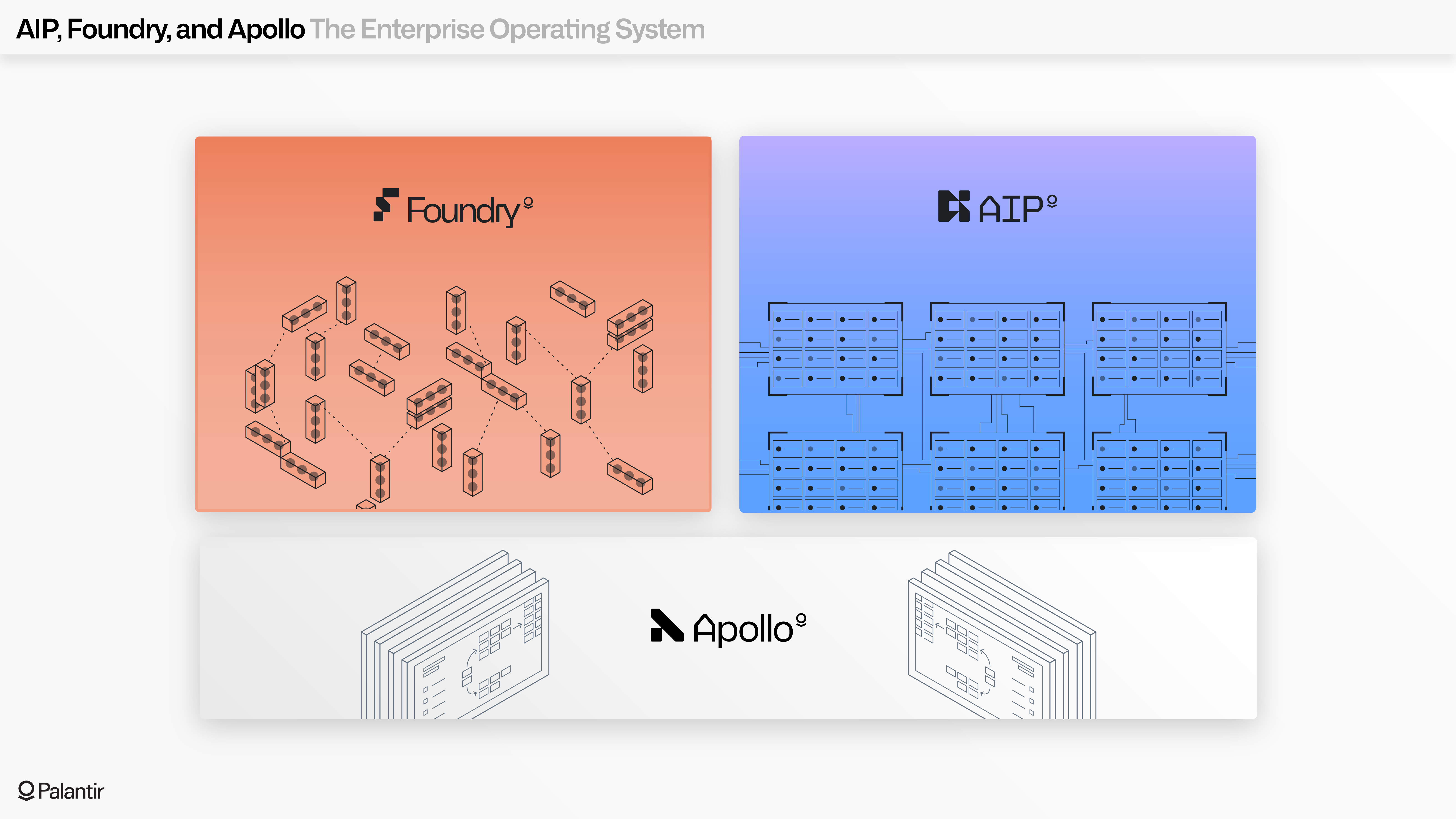 Foundry, AIP, and Apollo make up the Enterprise Operating System.
Capability Sets and Mesh-Wide Components
When combined, AIP + Foundry function conceptually across nine capability sets:
- Ontology system: Comprising the Ontology Language, Ontology Engine, and Ontology Toolchain (Ontology system);
- Core services: Data Services, Logic Services, and Workflow Services that power the Ontology system;
- Delivery & execution: Analytics & Applications, Automations, and a Product Delivery toolchain to achieve user goals.
These nine capability sets holistically leverage six mesh-wide components: Storage, Compute, Networking, Security, Governance, and the Workspace. All lateral components are powered by Apollo.
This architecture supports AI-enabled care operations at major hospital systems, integrated network planning for airlines, electric operations and wildfire response for large utilities, full-spectrum military operations across the U.S. and allied nations, and thousands of additional use cases. Customers leverage this Enterprise Operating System to connect data, analytics, and AI directly with mission-critical operations.
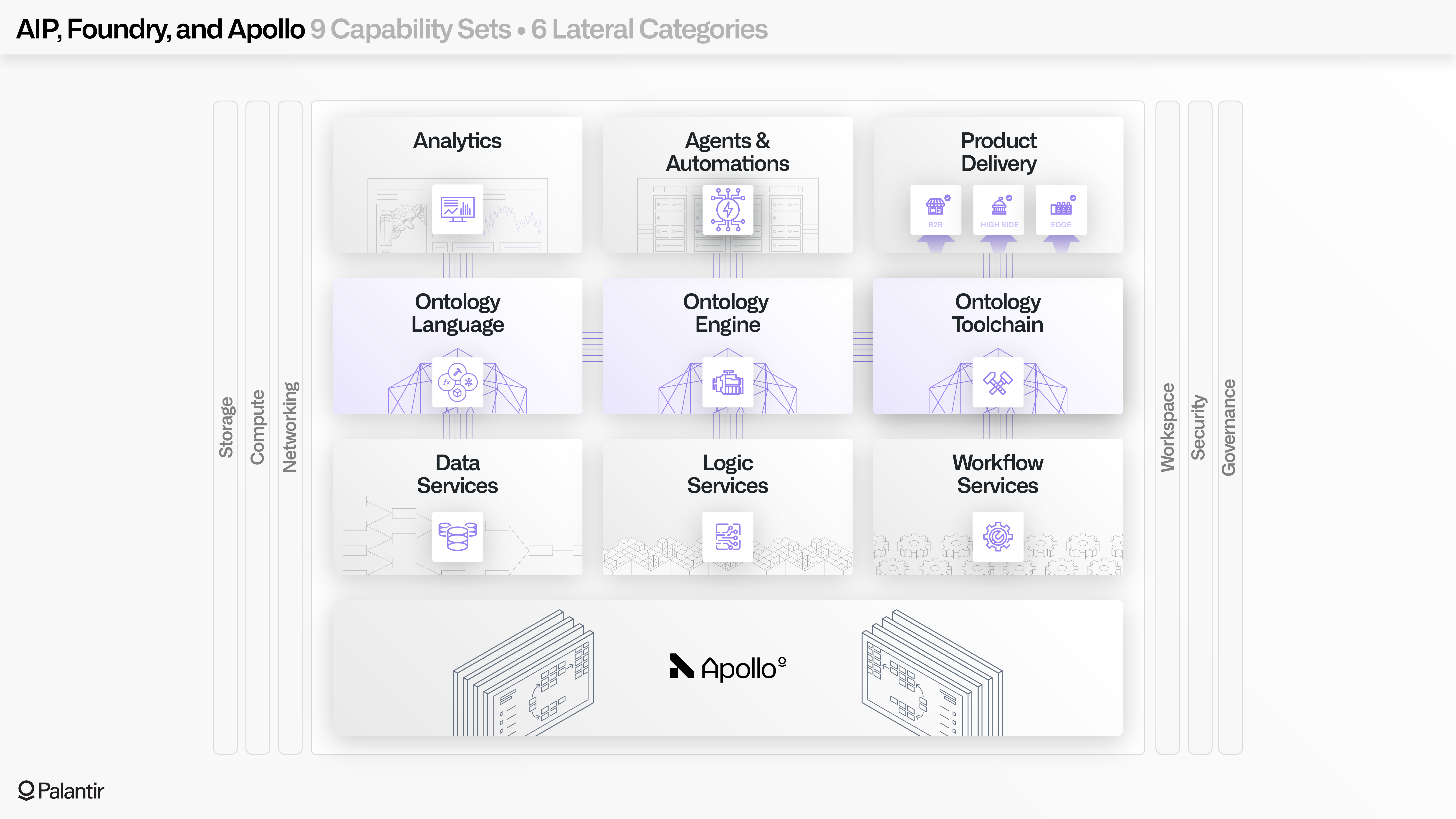 Illustration showing the 9 capability sets and six lateral categories of AIP+Foundry.
Unified Security Architecture
Security spans all three platforms across three primary spheres, creating a comprehensive trust framework:
Infrastructure Security: Every component in the Palantir service mesh operates on zero-trust principles. All elements are access-gated based on identity, device health, and verification, with an expectation of hostile attacks requiring autonomous enforcement (e.g., Apollo-mandated encryption, firewalls, and runtime configurations).
Platform Security: Foundry and AIP provide full-spectrum controls for trustworthy collaboration. This includes strict enforcement of access scopes for humans and agents, granular role-based, marking-based, and purpose-based access controls tied to automated lineage and auditing, plus a range of in-platform applications for interdisciplinary teams.
Enterprise Security: Foundational controls extend into enterprise-grade configurations, deeply integrating encryption, audit logging, authorization, and authentication with an organization’s existing identity providers, information security tools, and architectural patterns.
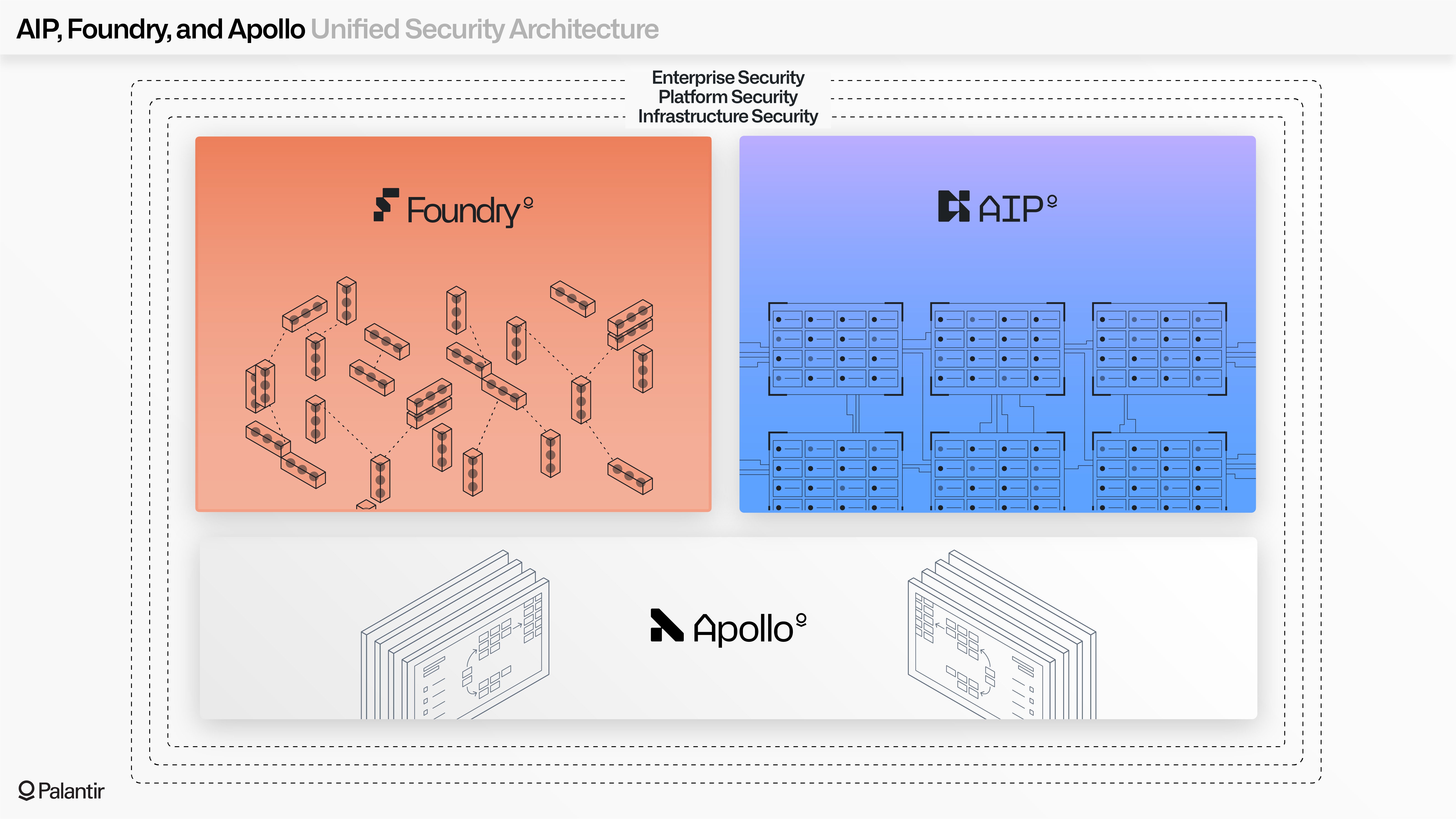 Illustration of platform security architecture: enterprise security, platform security, and infrastructure security.
Extensibility and Interoperability
The standard AIP + Foundry + Apollo architecture is explicitly designed to be extended and deeply integrated with external services and applications:
- Tactical Extension: Palantir’s Compute Modules framework allows developers to securely deploy their own containers—including containerized LLMs, optimizers, data processing runtimes, or end-to-end applications—directly into the Apollo-managed mesh.
- Defense Integration: Palantir Gotham’s core set of multimodal applications and tools, originally developed prior to the standard architecture, are now completely integrated and powered by the Foundry-managed Ontology.
- Commercial Ecosystems: Organizations extend the architecture in diverse ways, such as Airbus empowering an entire Aviation ecosystem (Skywise), Fujitsu building specialized agentic applications using Foundry and AIP toolchains, and Andretti Racing developing "RaceOS" to connect real-time car performance into AI-powered applications.
The architecture also scales across specialized vertical offerings:
- Healthcare: Enables hospitals to build custom care operations and applications on top of the core platform (Palantir for Hospitals).
- Manufacturing: "Warp Speed" operates as a dedicated manufacturing operating system (Palantir Warp Speed).
- Defense: Builds high-stakes, specialized applications for demanding military and allied use cases using the same core architecture (Palantir Defense).
Pursuing Alpha vs. Beta
The standard architecture’s goal is to deliver non-standard results through extreme differentiation via maintainable customization.
In financial terms, a successful Palantir deployment helps an enterprise pursue alpha: generating outsized returns by building around core differentiation, infusing organizational particularities directly into the ontology, and adapting in real-time to complex operational conditions to meet strategic objectives.
Conversely, beta represents the pursuit of low-hanging fruit, such as basic solutions typical of one-size-fits-all SaaS deployments. While Palantir’s architecture can support beta-level use cases, these are ideally meant to function only as byproducts of a broader alpha-focused strategy. Customers should eventually wield the constellation of Apollo-managed services to build custom applications, integrations, and agent fleets that address their most critical problems.
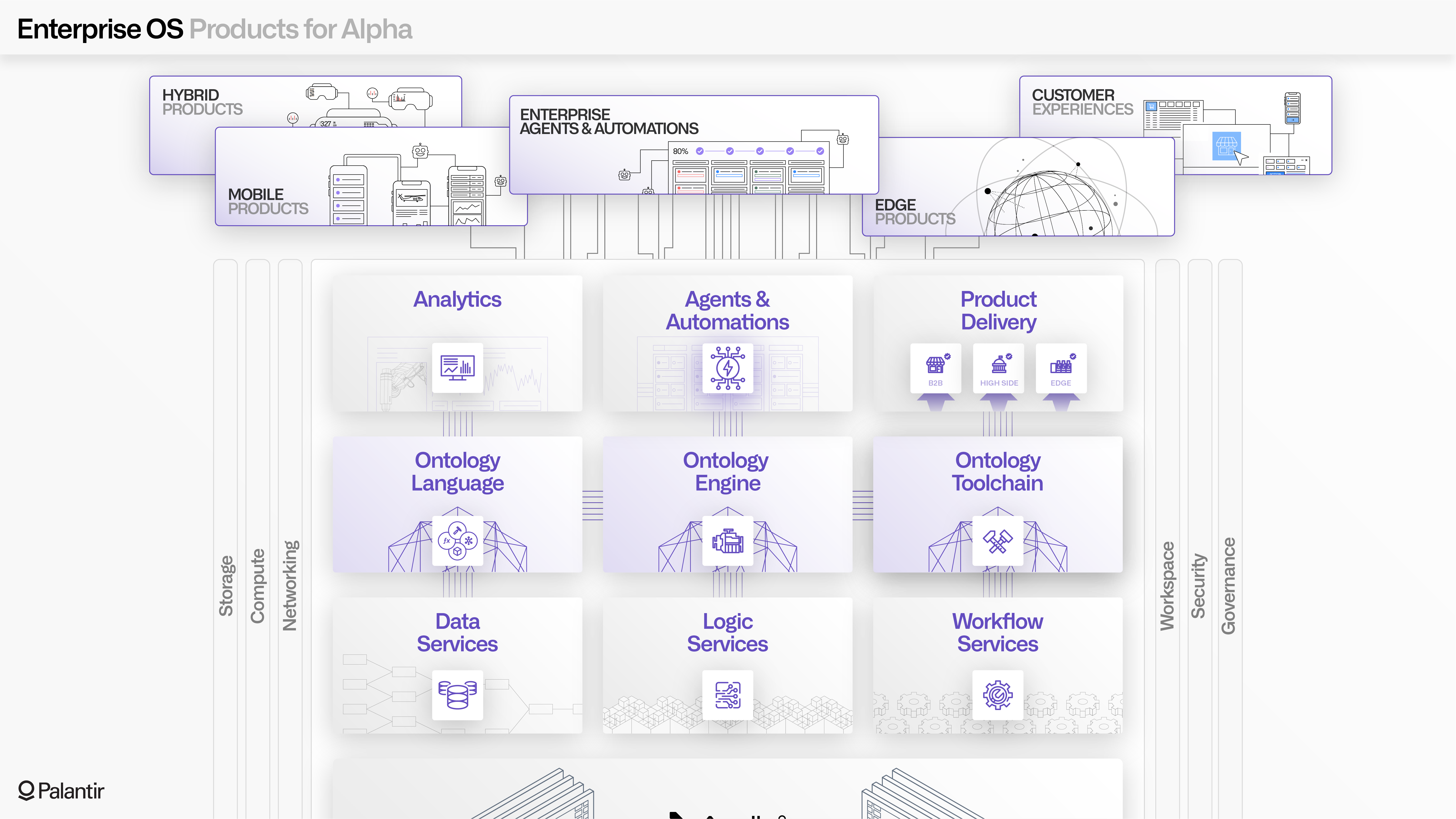 Illustration of how Palantir provides products for "alpha".
Forward Deployed Engineering
The dynamism of AIP, Foundry, and Apollo collectively reflect a product development paradigm known as Forward Deployed Engineering. This approach functions as the human equivalent of backpropagation. Palantir engineers are deeply embedded in critical environments worldwide—from war zones to factory floors—walking alongside customers and tirelessly building and shipping new features directly in operational contexts.
Driven by customer missions, this methodology ensures that every deployment of the standard architecture evolves into the enterprise’s unique, one-of-one, ever-evolving operating system tailored to real-world demands.
Key Takeaways
- Three integrated platforms: Apollo manages infrastructure and continuous delivery; Foundry handles data operations & Ontology development; AIP delivers generative AI, agents, and LLM connectivity.
- Nine capability sets across six lateral components: The system maps Ontology, services, and tools onto Storage, Compute, Networking, Security, Governance, and Workspace to power complex missions.
- Trifecta security model: Zero-trust infrastructure, granular platform access controls, and deep enterprise identity integration ensure secure, auditable operations.
- Purpose-built over out-of-the-box: The architecture emphasizes extending capabilities via Compute Modules and custom verticals (healthcare, manufacturing, defense) to pursue organizational "alpha" rather than generic SaaS deployment.
- Human-centric development: Forward Deployed Engineering embeds developers directly in customer environments, treating software as a continuously adapting operating system rather than a static product.
Learning map
Stage 1: Platform Foundations
- Understand the roles of each platform: Apollo (infrastructure orchestrator), Foundry (data + Ontology system), AIP (generative AI agent framework)
- Learn how zero-trust and unified security map across all three layers
Stage 2: The Ontology System
- Study the Ontology Language, Engine, and Toolchain as the data layer's core
- Map how Data Services, Logic Services, and Workflow Services power ontology operations
Stage 3: AIP Agent Development
- Explore the k-LLM paradigm for secure LLM connectivity
- Practice building automations using AIP's agent toolchain and Evals framework
Stage 4: Infrastructure & Deployment Model
- Study how Apollo orchestrates zero-downtime upgrades at scale
- Understand Compute Modules as the extensibility mechanism (BYO containers, custom runtimes)
Stage 5: Real-World Delivery Patterns
- Review forward-deployed engineering methodology as Palantir's development model
- Examine use cases (hospitals, airlines, utilities, defense) as reference architectures
Get hands-on — step by step
- Open Palantir's architecture overview at https://www.palantir.com/docs/foundry/architecture-center/platforms/ to map the big-picture topology.
- Navigate to the Ontology system documentation at https://www.palantir.com/docs/foundry/architecture-center/ontology-system/ and sketch how data, logic, and workflow services interlock.
- Read the AIP agent concepts section in the developer docs to understand the k-LLM paradigm and end-to-end agent lifecycle.
- Follow the Compute Modules overview at https://www.palantir.com/docs/foundry/compute-modules/overview/ to see how custom containers integrate into Apollo's managed mesh.
- Map your own organization's capabilities onto Palantir's nine capability sets / six lateral categories diagram and identify which components you would map to your current stack.
- Draft a brief architecture proposal for one real use case (e.g., healthcare care coordination) by writing each of the three layers' role and the security controls between them.
Top 3 sources
- 1Palantir Foundry Architecture Center — Enterprise OS
The canonical documentation for AIP, Foundry, and Apollo's integrated architecture, security model, and extensibility.
https://www.palantir.com/docs/foundry/architecture-center/platforms/
- 2Palantir Ontology System
Official guide to the Ontology Language, Engine, and Toolchain that power Foundry's data operations layer.
https://www.palantir.com/docs/foundry/architecture-center/ontology-system/
- 3
Links are AI-suggested — worth a quick sanity check before diving in.