Architecture center Overview
7/29/2026, 8:35:15 PM · updated 7/29/2026, 8:53:05 PM · Source
An exploration of Palantir's enterprise architecture — covering its three core platforms (AIP, Foundry, Apollo), the Ontology system that unifies data and AI agents, and the service layer that powers analytics, automation, and custom solutions.
Palantir’s platforms and offerings are continuously developed through the methodology of Forward Deployed Engineering. This is the human equivalent of backpropagation, in which teams of engineers get as close as possible to a problem while working in concert with core engineering teams to relentlessly synthesize feedback and ship new features.
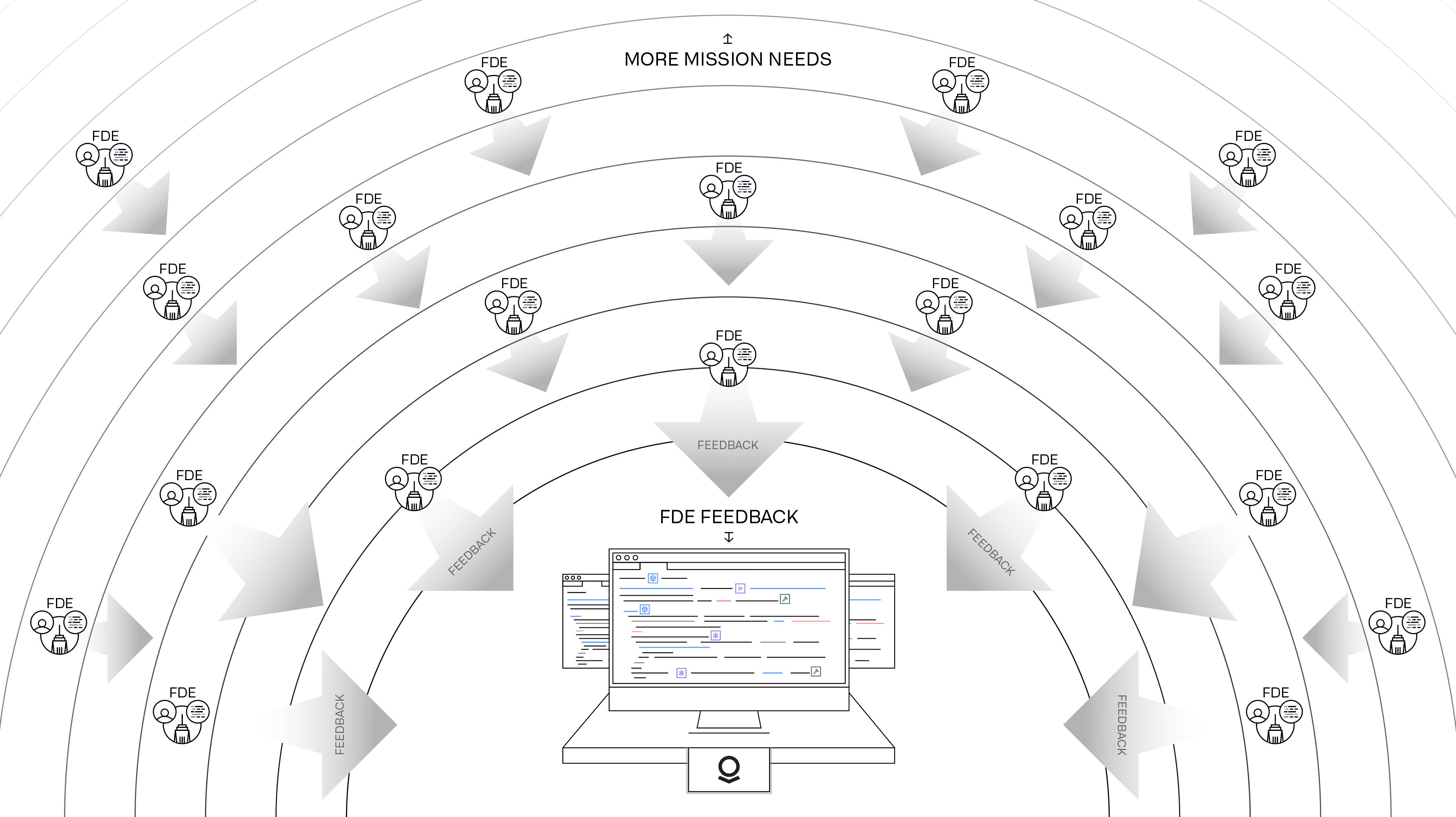 Illustration of FDEs sending feedback from the field.
Across every sector, Palantir operates with a common architecture consisting of three platforms: AIP, Foundry, and Apollo. These platforms are collectively designed to function as an enterprise operating system. Foundry serves as the core Data Operations platform; AIP serves as the Generative AI platform; and Apollo is the continuous delivery platform that underpins them.
AIP and Foundry collectively consist of 300+ microservices and assets, all running in a highly available and autoscaling compute mesh, atop zero-trust security infrastructure that enforces a rigorous security posture across every component (for instance, aggressive node cycling to guard against advanced persistent threats).
Domain-specific offerings, such as those in Defense and Intelligence or the increasingly rich set of applications focused on Hospital Operations, extend the underlying capabilities of AIP and Foundry. This complex orchestration of foundational services and comprehensive operational offerings is only possible through Apollo’s autonomous approach to software delivery.
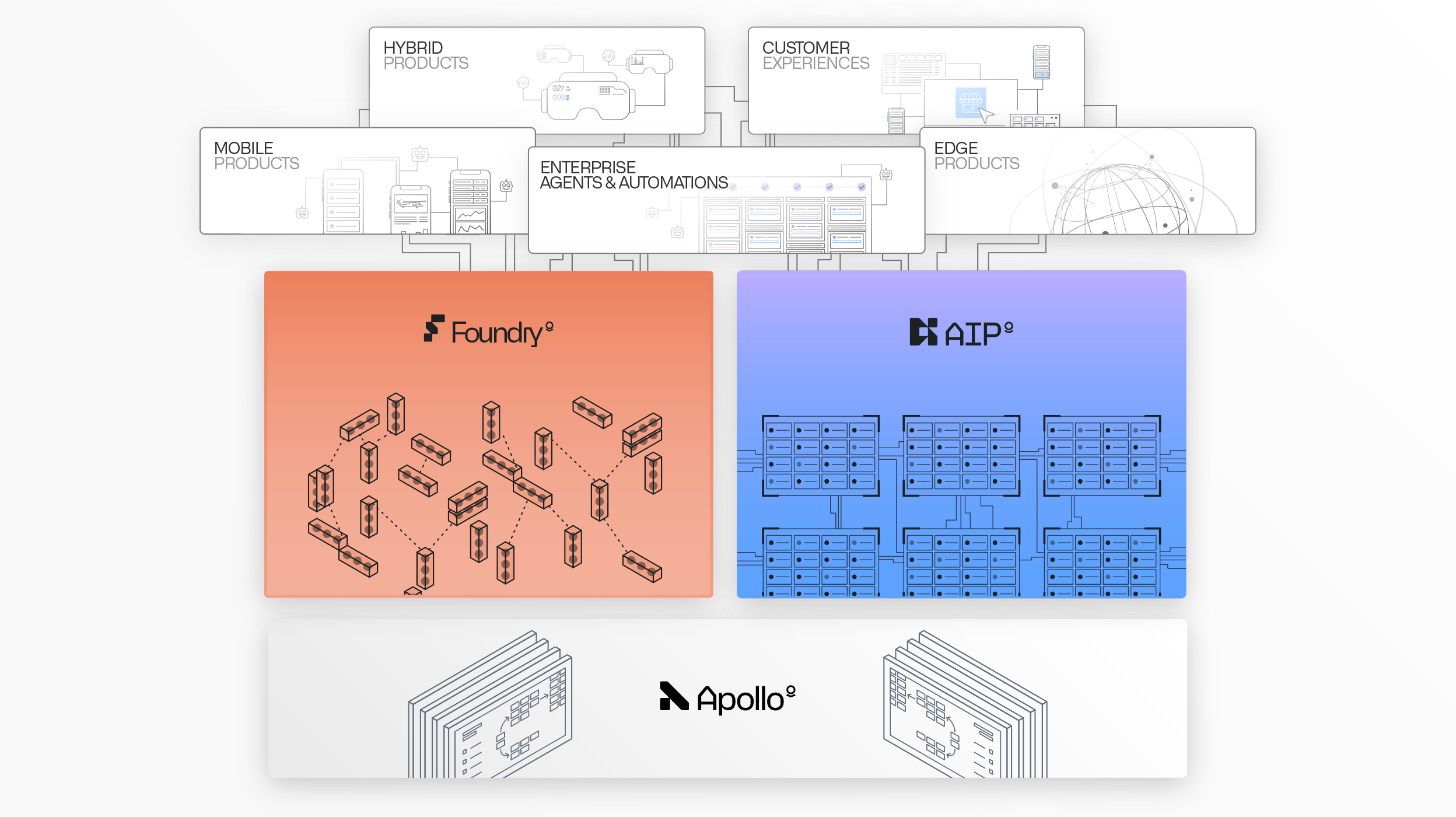 Illustration of the relationship between AIP, Foundry, Apollo, and Palantir's products.
The heart of Palantir’s architecture is the Ontology system. The Ontology integrates an enterprise’s data, logic, action, and security policies into an intuitive representation that both humans and AI agents can wield.
In a supply chain context, the Ontology might be used to integrate dozens of fragmented ERP, MES, CRM, customer, edge, and myriad other data sources into a common set of objects, or "nouns" - the manufacturing plants, production lines, customer orders, and other core concepts that constitute the operational world.
These "nouns" are paired with "verbs", which are actions that must be orchestrated across workflows, such as updating purchase orders, changing distribution strategies, or running multi-step simulations to assess how to address a supply disruption.
Each of these nouns and verbs can be powered by the full range of logic, from business rules, machine learning models, and optimizers to computations that chain together multiple engines across computing environments.
Multimodal, military-grade security controls encompass the objects, links, actions, functions, and other semantic and kinetic primitives all modeled inside the Ontology. This ensures that both humans and AI agents can orchestrate across the Ontology, but with the precision and guardrails required to sustain trust.
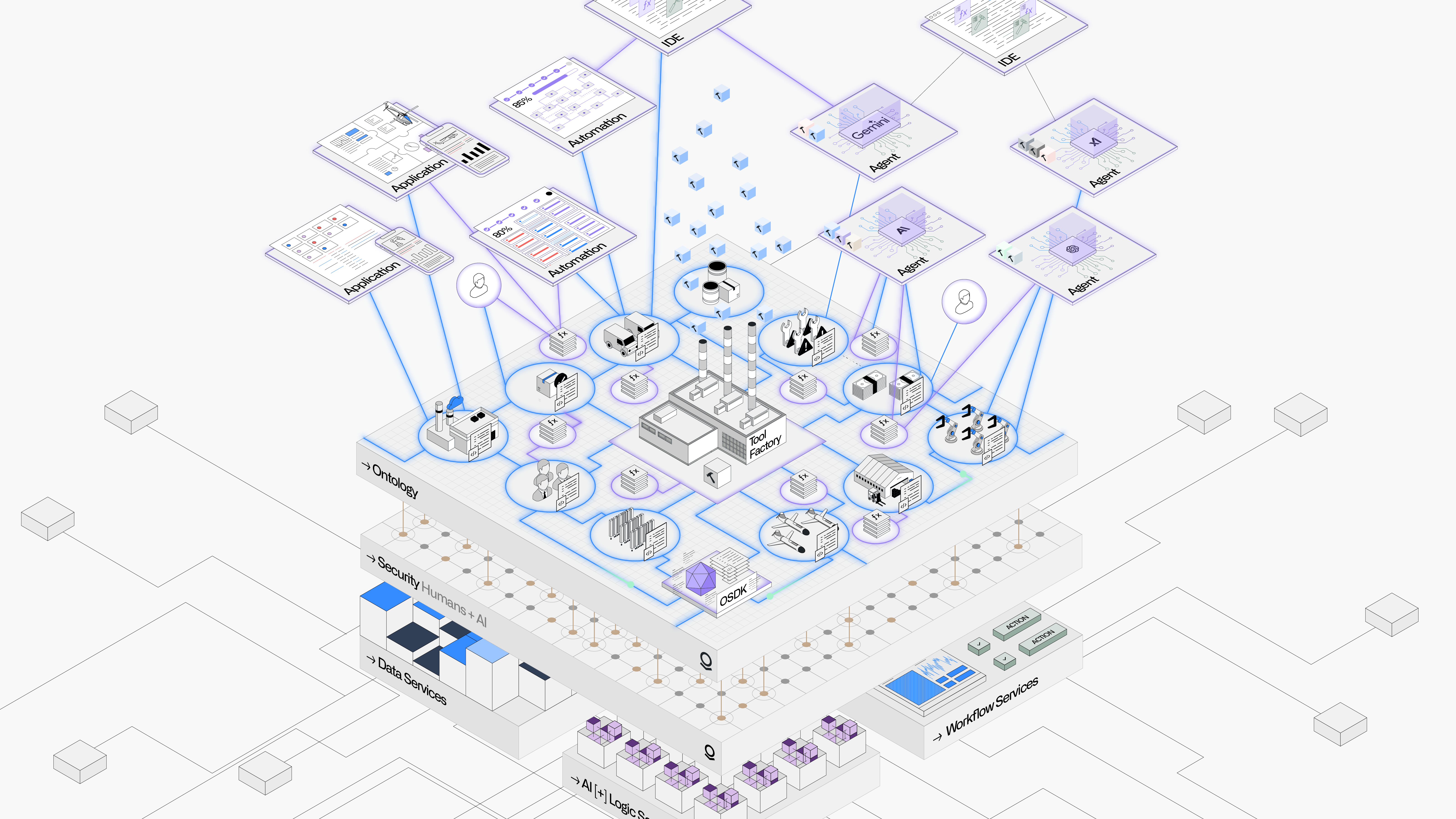 Illustration of the Ontology as a layer; above are applications, automation, and agents, below are governance, data services, logic services, and workflow services.
There are hundreds of services that work in concert with the Ontology system, including Data Services, Logic Services, and Workflow Services.
- Data Services encompass data connectivity, data transformation, data virtualization, data storage, data health monitoring, and data management.
- Logic Services encompass authoring business rules, training machine learning models, orchestrating external models, integrating LLMs and other forms of Generative AI, end-to-end Model Ops and Agent Ops, and more.
- Workflow Services enable interactive compute for analytical and operational use-cases, event-driven automations, scheduled automations, pro-code and low-code workflow authoring tools, and more.
All of these capabilities are natively connected with the Language, Engine, and Toolchain that constitute the Ontology system. Together, this enables a wide variety of analytics, applications, AI-driven agents and automations, and custom products to be built atop Palantir's architecture, all of which leverage platform-wide approaches to change management and release management, and which adhere to the security and governance controls configured by administrators.
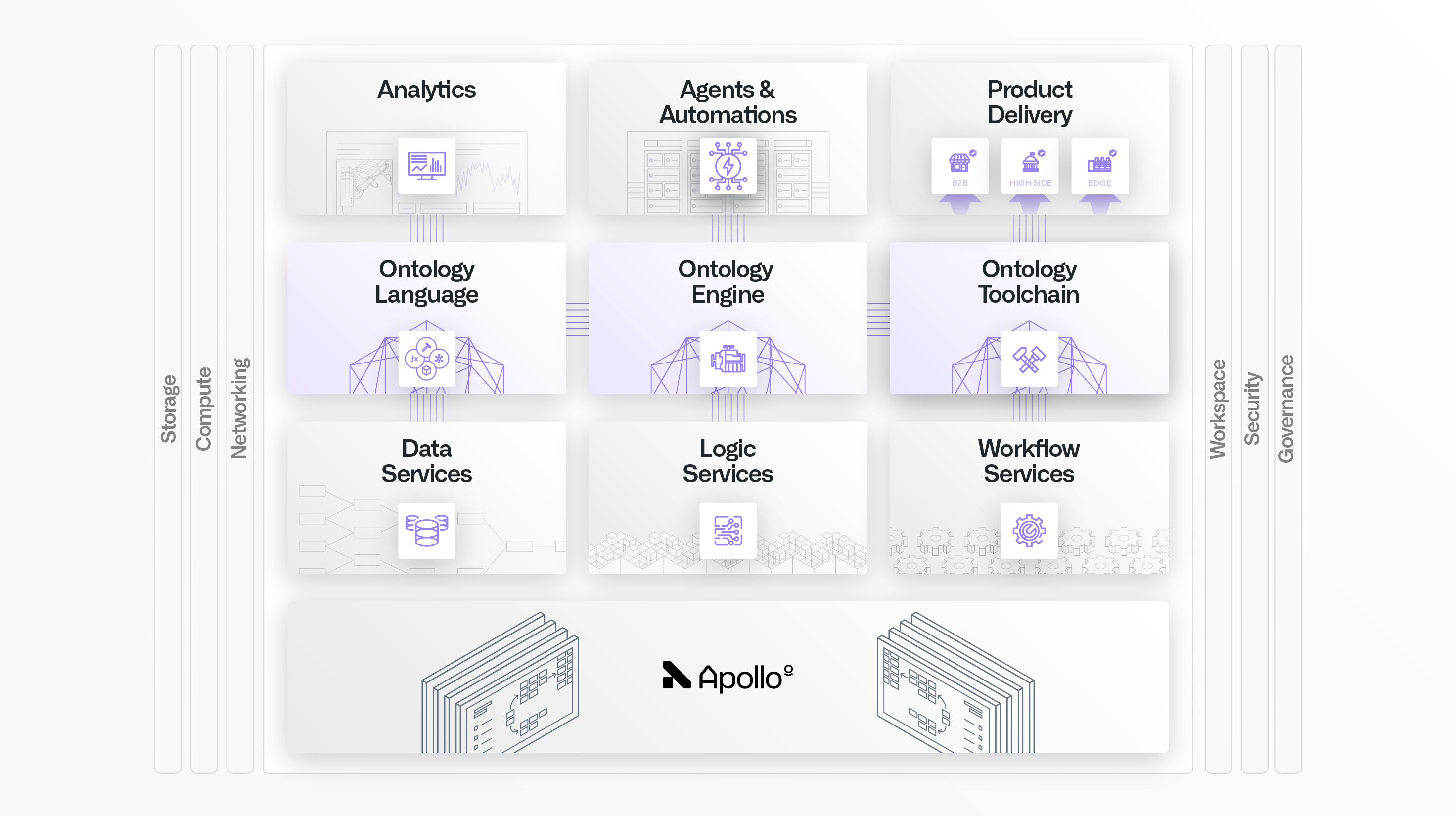 Grid of Palantir services and capabilities: the top row has analytics, agents & automations, and product delivery; middle row has Ontology language, Ontology engine, and Ontology toolchain; bottom row has data services, logic services, and workflow services.
This Architecture Center highlights topics that are most relevant for those working in enterprise architecture and digital strategy. These topics include:
- The Ontology system;
- Palantir’s open data and compute architecture, known as the Multimodal Data Plane;
- The reference architecture for building AI-driven agentic workflows;
- Details on the infrastructure and security paradigms.
Thanks to the Apollo platform, which orchestrates tens of thousands of releases per week, every deployment is a living environment. Even so, Palantir's commitment to powering our customers’ most important missions means that we want to ensure that stewards and stakeholders of Palantir deployments are always equipped to build, maintain, and scale maximally robust solutions, which can each be counted on to meet their moments.
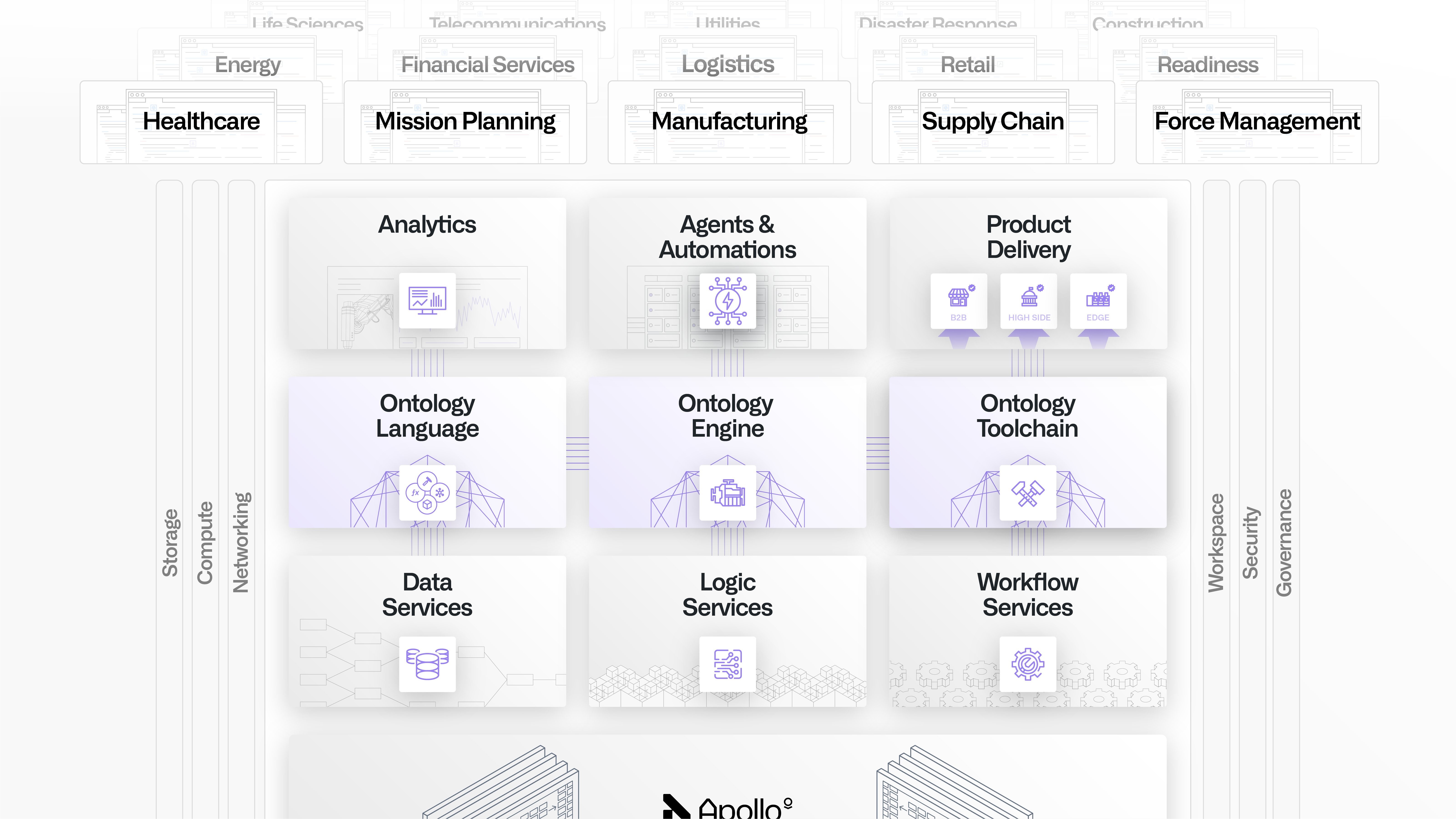 Illustration of the industries powered by Palantir, including healthcare, mission planning, manufacturing, supply chain, force management, energy, financial services, logistics, retail, readiness, life sciences, telecommunications, utilities, disaster response, and construction.
Learning map
Stage 1: Foundations
describe
- Explore the Palantir Architecture Center overview at your own pace.
- Learn the distinction across Foundry (Data Operations), AIP (Generative AI), and Apollo (Continuous Delivery).
Stage 2: Deep Dive — The Ontology System
describe
- Study how the Ontology translates raw enterprise data into "nouns" and "verbs" for human and agent use.
- Understand nouns (objects like plants, orders) vs. verbs (actions like updating purchase orders, running simulations).
Stage 3: Services Layer
Describes:
- Deep dive into Data Services, Logic Services, and Workflow Services.
- Learn how they connect to the Ontology's Language, Engine, and Toolchain.
Stage 4: Real-World Application
ds:
- Apply concepts to one of Palantir's industry scenarios (supply chain, hospital operations, etc.).
- Evaluate security controls — Multimodal, military-grade guardrails for trust and governance.
Get hands-on — step by step
- Open the Palantir Architecture Center in your browser.
- Read the "Platforms" section: identify AIP's role (Generative AI), Foundry's role (Data Operations), and Apollo's role (Continuous Delivery).
- Navigate to the Ontology system page, focusing on how the Ontology layer maps data sources into objects and actions.
- Compare Data Services vs. Logic Services vs. Workflow Services — make a table of what each covers.
- Pick one industry use case mentioned (e.g., supply chain) and trace through how its nouns, verbs, services, and security layers interact.
- Review the Multimodal Data Plane and Rubix Security sections to understand data isolation, governance, and threat mitigation.
- Sketch your own simplified diagram: top layer = apps/agents, middle = Ontology (noun/verb/objects), bottom = data sources + compute mesh.
Top 3 sources
- 1Palantir Architecture Center — Overview
The official deep-dive into Palantir's platform architecture, ontology system, and forward deployed engineering methodology.
https:// www.palantir.com/docs/foundry/architecture-center/overview/
- 2Palantir Foundry Docs
Comprehensive documentation for the data operations platform — its capabilities, integrations, and governance model.
https://www.palantir.com/docs/foundry/
- 3Palantir AIP Documentation
Reference material for the Generative AI platform — building agentic workflows, integrating LLMs, and deploying AI-driven solutions.
https://www.palantir.com/docs/aip/
Links are AI-suggested — worth a quick sanity check before diving in.