Must-read before studying Claude's source code
7/19/2026, 12:43:51 PM · Source
This article outlines the background of the Claude Code source code reconstructed from the source maps of npm distribution artifacts, defines its research positioning as a reference sample for AI Agent system architecture, and provides a systematic analysis path along with essential prerequisite knowledge.
Before embarking on the study of the Claude Code source code, we need to clarify a core background: the code currently available for research is not an officially open-sourced version by Anthropic, but rather a source code snapshot reconstructed through reverse engineering from the source maps leaked in its npm distribution artifacts. This article will thoroughly guide you through the origins, core value, learning path, and acquisition methods of this source code, helping you explore it efficiently with a clear understanding.
Source Code Background: How Did It Leak?
The Claude Code source code you are about to study was not acquired through regular open-source channels.
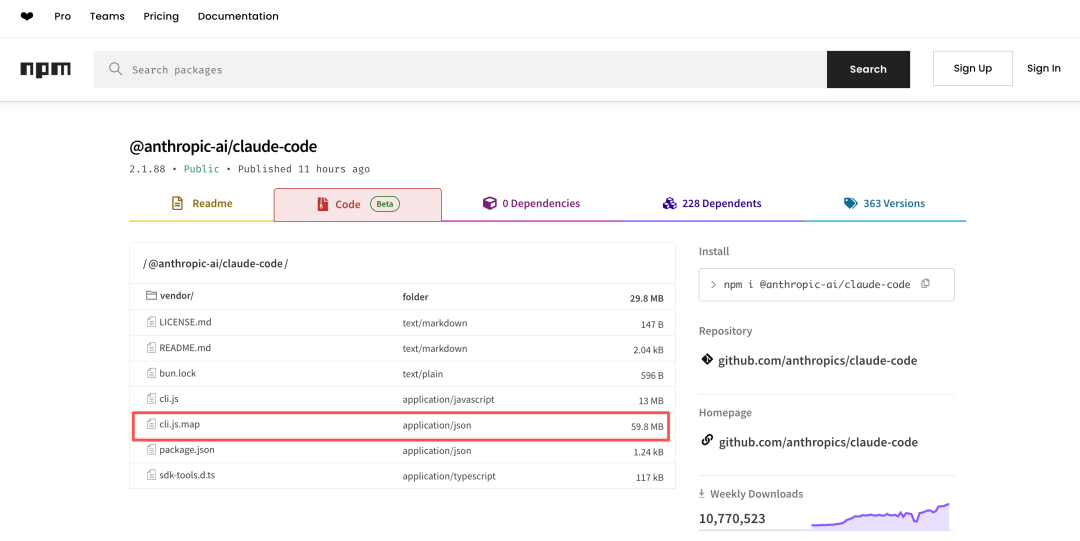 Source Code Background
For detailed background on this event, please refer to: Just Now, Claude Code Source Code Leaked!
The core technical background behind how this code made its way to the community is as follows:
- Not Officially Open Source: As a commercial product, the Claude Code core was not originally open-sourced.
- Residual Debug Information: Its npm distribution artifacts contained traceable source map information.
- Reverse-Engineered Source Code: Based on this, developers successfully reconstructed a large amount of TypeScript source code and compiled it into a source code mirror for analysis.
Core Understanding: What we are studying now is not an official GitHub open-source project, but a source code snapshot reverse-engineered from clues in the distribution package.
Source Code Origin Path Diagram
Why Is This Source Code Drawing So Much Attention?
Claude Code represents one of the most cutting-edge product forms among current AI Coding Tools. It is a tool-calling Agent that integrates a variety of complex capabilities, containing internally:
- Command Line Agent (CLI Agent)
- Multi-turn Engineering Task Execution System
- A complete runtime (Runtime) equipped with permission management, state management, MCP (Model Context Protocol), LSP (Language Server Protocol), plugins, and remote sessions.
In daily use, we can only perceive its interactive interface without peering into its internal design. The emergence of this source code mirror allows developers, for the first time, to directly dissect the real architecture of Claude Code from the implementation level.
The Value Boundaries of This Code: What It Can and Cannot Do
Before diving deep, it is essential to establish rational expectations and clarify the boundaries of using this code.
1. What This Code Is Suitable For
- Studying Architectural Design: Dissecting the overall system architecture and module division of Claude Code.
- Researching Engineering Implementation: Learning from the engineering implementation methods of AI coding Agents.
- Referencing Core Mechanisms: Studying its excellent designs in tool protocols, permission management systems, context assembly, and runtimes.
We should treat it as an excellent system architecture specimen to understand "why it is powerful", "how it organizes the system", and "how its capabilities are assembled", rather than simply trying to replicate it.
2. What This Code Is Not Suitable For
- Direct Compilation and Execution: It is not suitable as a 100% complete and directly runnable project.
- Equating to the Latest Version: It does not represent the official latest online version.
- Relying on Complete Services: It does not include all private services and backend dependencies.
- Secondary Commercial Release: It is not suitable for secondary distribution as a production project.
Recommended Learning Path and Prerequisites
Recommended Learning Path
When studying this source code, it is not recommended to "struggle with files one by one". Instead, you should follow a top-down, progressive logic:
This topic has been designed as a complete, step-by-step system disassembly course, rather than a collection of scattered code fragments, aiming to help you systematically digest these contents.
Essential Prerequisites
To avoid getting stuck when reading core files such as main.tsx, QueryEngine.ts, and Tool.ts, it is recommended that you have the following basic knowledge beforehand:
- Terminal and Command Line basics
- File Path and Directory operations
- Git basic usage
- Basic reading ability of TypeScript / React code
- Basic concepts of AI Agents
How to Obtain This Source Code
Regarding the complete origin and background of this source code, it is recommended to first read the prerequisite article: Just Now, Claude Code Source Code Leaked!.
To ensure the stability of the acquisition channel and the continuous follow-up of subsequent updates, it is recommended to obtain it via the WeChat Official Account:
- Scan the QR code to follow the official account below.
- Send the keyword:
ClaudeorClaude源码. - Follow the instructions in the auto-reply to get the download link.
 Official Account QR Code
Why follow before downloading? There might be subsequent patches or explanatory updates to the source code files. Following the official account ensures that you continuously receive the latest learning paths, analysis articles, and complete contextual explanations, avoiding the dilemma of "having the source code but being unable to digest it."
## Key takeaways
- Not Officially Open Source: The Claude Code source code currently being studied is not an official open-source version, but rather a source code mirror reverse-engineered from source maps in npm distribution artifacts.
- Core Research Value: This source code is an excellent architectural specimen for studying AI coding Agents, toolchain design, MCP/LSP runtimes, and multi-turn engineering task execution.
- Rational View of Limitations: The code does not include complete backend dependencies and is not suitable for direct production use or secondary commercial release.
- Systematic Learning: It is recommended to read systematically in the order of
启动入口 -> 主循环 -> 工具系统 -> 上下文与状态 -> 协议与插件.
Learning map
Claude Code Source Code Learning Roadmap
Phase 1: Prerequisites and Foundations
- Terminal and Command-Line Interaction: Understand how CLI tools work, and familiarize yourself with stdin/stdout streams and how the React Ink library renders in the terminal.
- TypeScript and React Basics: Have the ability to read strong TS type definitions, decorators, and React component-based development (used for terminal UI rendering).
- Core Agent Concepts: Master the basic principles of Tool Calling and the ReAct loop (Reasoning and Acting).
Phase 2: System Skeleton & Initialization
- Entrypoint main.tsx Dissection: Analyze parameter parsing, dependency injection, and environment initialization logic upon program startup.
- State Management (AppState): Study how the system maintains global context such as current sessions, history, and permission states.
Phase 3: Core Loop Engine Investigation
- QueryEngine Operating Mechanism: Analyze how the main loop receives user input, calls the Anthropic API, parses responses, and dispatches execution tasks.
- Tool / tools Protocol Implementation: Delve into how Claude Code defines tool schemas, performs parameter validation, and executes local/remote tools.
Phase 4: Advanced Ecosystem and Integrations
- MCP Protocol Integration: Understand the Model Context Protocol specification, and study how Claude Code dynamically loads external contexts and services via MCP.
- LSP & Security: Learn how it reads codebase structures, as well as the permission interception and user confirmation mechanisms before executing high-risk system commands.
Get hands-on — step by step
-
Prepare the analysis environment: Install Node.js (v18+ recommended) and VS Code. Ensure
typescriptis installed globally to inspect type definitions at any time. -
Obtain and structure the source code: After obtaining the restored source code of Claude Code, open the folder in VS Code. Focus on the project directory structure under
src/to locate the core modules (typically includingmain.tsx,QueryEngine.ts, or related Agent core logic files). -
Trace the startup flow (Entrypoint): Open
main.tsxand find the entry function (such asmain()orrun()). On paper or using a drawing tool, document the process from the moment a user enters a command in the command line to the rendering of the first UI component, noting what environment checks and configuration initializations take place in between. -
Analyze the core Agent loop (Core Loop): Locate the engine file handling multi-turn conversations (such as
QueryEngine.ts). Look forwhileloops or recursive calls to observe how it leverages JSON/XML tags returned by the LLM to determine the next action, especially how it constructs the System Prompt. -
Simulate a custom Tool locally: Referencing the structure of a simple tool (such as file reading or directory listing) in the
tools/directory of the source code, write a class namedmy_custom_tool.tsby hand. Implement itsexecute,description, andinputSchemainterfaces to understand how Claude statically analyzes and invokes it.
Top 3 sources
- 1Anthropic Claude Code Official Documentation
官方关于 Claude Code 命令行工具的使用指南,能帮助你快速建立对该产品实际功能与交互界面的感性认知。
https://docs.anthropic.com/en/docs/agents-and-tools/claude-code
- 2Model Context Protocol (MCP) Official Site
Anthropic 官方开源的上下文协议标准,是理解 Claude Code 能够动态链接各种外部数据源和工具的核心理论基石。
https://modelcontextprotocol.io
- 3TypeScript Deep Dive 中文版
优秀的 TypeScript 开源教程,能帮助你快速补齐阅读 Claude Code 复杂类型定义、泛型及异步流所需的 TS 核心基础知识。
https://jkchao.github.io/typescript-book-chinese/
Links are AI-suggested — worth a quick sanity check before diving in.