The Multimodal Data Plane
7/29/2026, 9:33:28 PM · Source
The Multimodal Data Plane (MMDP) unifies fragmented enterprise data sources, heterogeneous compute runtimes, and generative AI models via Apache Iceberg's open standard to enable vendor-agnostic workflows without data duplication.
The Multimodal Data Plane
The Multimodal Data Plane (MMDP) is Palantir’s open architecture designed to eliminate the friction between analytical and operational systems. By unifying fragmented data sources, heterogeneous compute runtimes, and a wide array of generative AI models into a single fabric, MMDP enables enterprise autonomy and seamless end-user experiences at any scale.
Any Data: MMDP's Open Data Architecture
The bedrock of MMDP is an open data architecture built around Apache Iceberg as the primary table format for Foundry and AIP. Recognized as an open standard across key partners including AWS, Google Cloud, Microsoft Azure, Databricks, and Snowflake, Iceberg allows Iceberg catalogs to be managed natively within Palantir, or registered as virtual catalogs and tables from external providers. This approach ensures that leveraging data in the Ontology for operational applications and AI-driven automations never requires data duplication.
Because MMDP supports standard tools like SQL applications and analytical notebooks, teams can securely interact with and manipulate data in Foundry and AIP just as they would in any other environment. Many organizations are actively building a “data mesh” (or an emerging “AI mesh”) that treats Palantir as one participant within a broader enterprise architecture. MMDP explicitly supports these mixed environments by acting as an “unwalled garden,” enabling end-to-end delivery of outcomes while ensuring every architectural layer integrates deeply with existing data lakes, lakehouses, conventional warehouses, governance tools, and storage repositories.
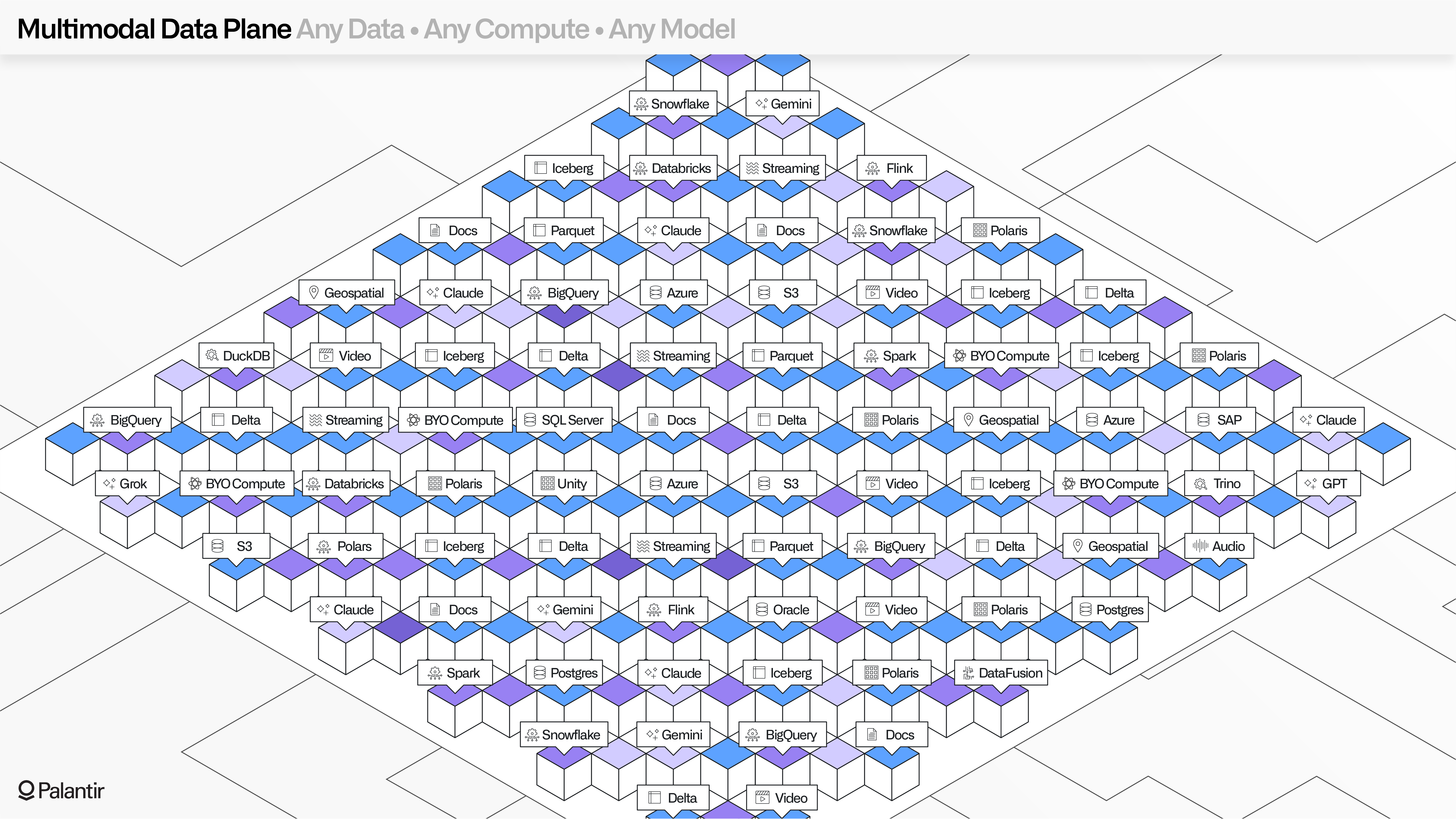
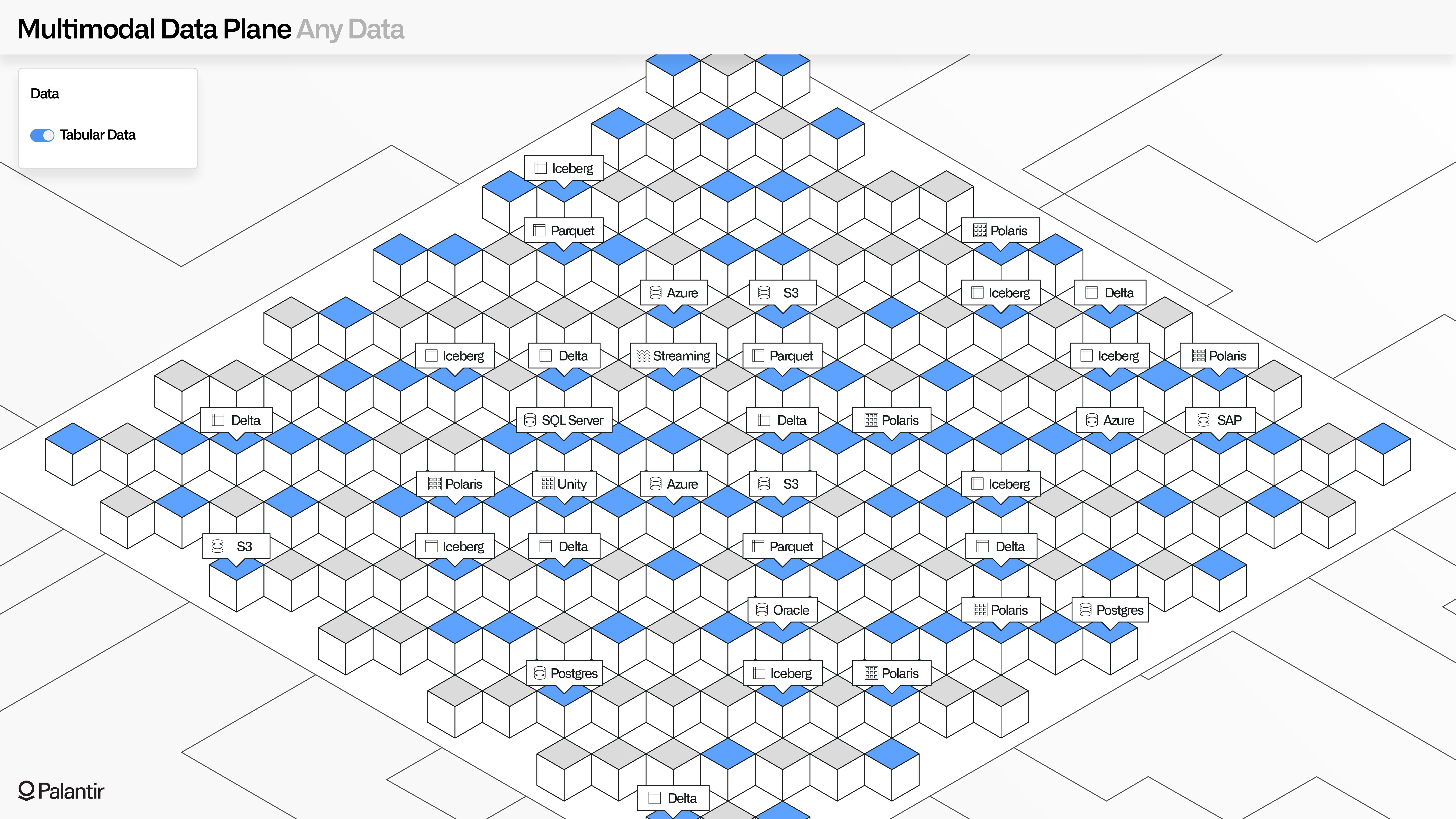
MMDP: Openness Beyond Tabular Data
MMDP extends the same open guarantees to non-tabular formats, including media, documents, streaming data, geospatial data, and other multimodal types.
- Media data can be synchronized with minimal assumptions about underlying formats. Recognized formats receive immediate interactive parsing via analytical tools, while custom or niche formats can have metadata lazily appended from other sources.
- Streaming and geo-temporal data often carry associative metadata (e.g., sensor tags) that require parallel processing in a data pipeline running alongside the primary ingestion pipeline.
However the data is ingested or transformed, all underlying files and data points are securely accessible through standard REST APIs, as well as Python and TypeScript SDKs. Export jobs and Ontology-based webhooks provide straightforward, secure synchronization to external systems regardless of modality, while the Source-based Transforms paradigm allows developers to leverage the full Foundry toolchain to customize data egress with granular workflow-level control.
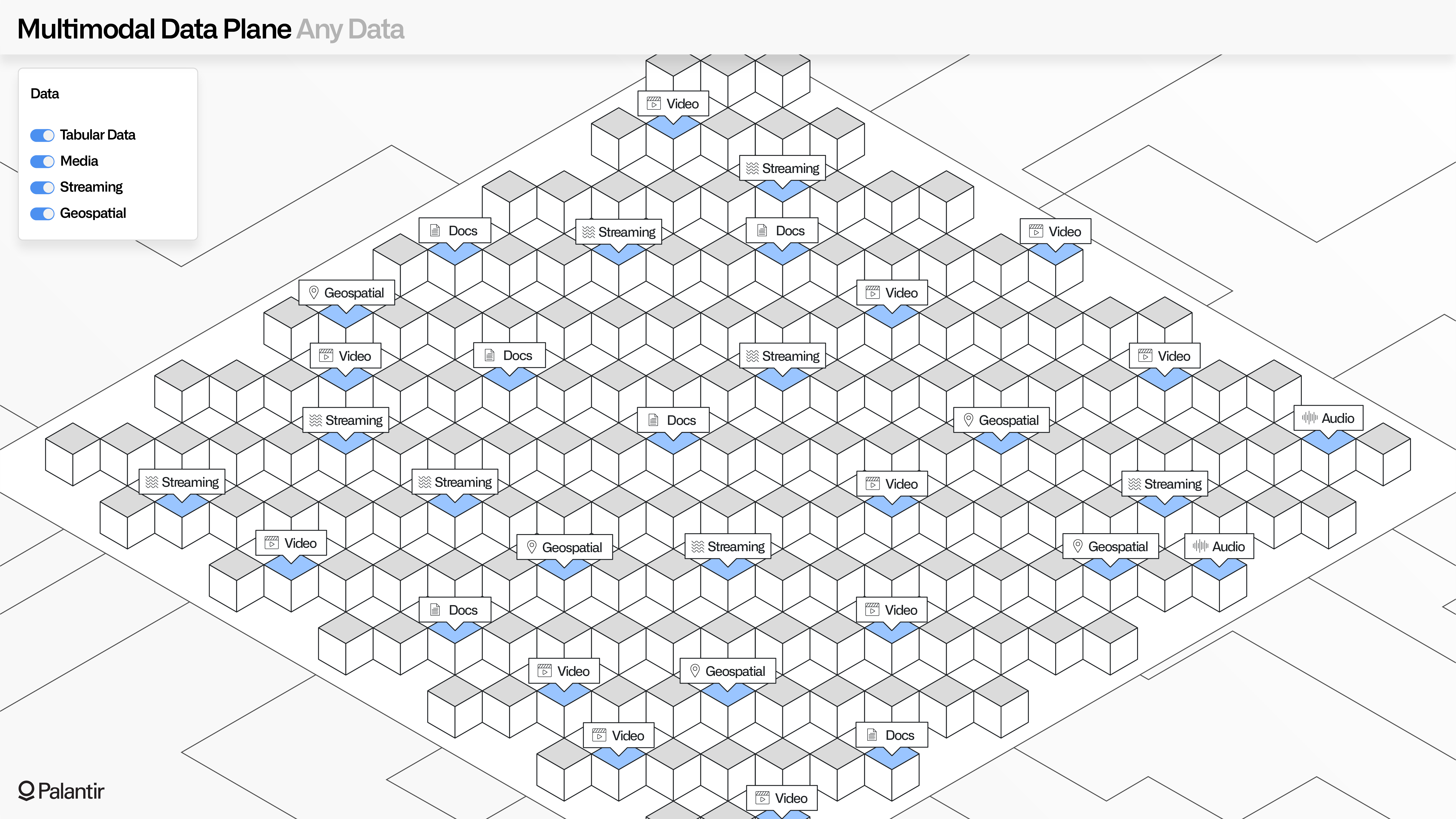 Illustration showing example data sources (tabular, media, streaming, and geospatial) supported by MMDP with title "Any Data".
Any Compute: MMDP's Open Compute Architecture
MMDP’s open compute architecture unlocks the full value of its open data foundation. Foundry and AIP ship with a suite of out-of-the-box runtimes, all operating on a hardened, autoscaling Kubernetes-based compute mesh known as Palantir Rubix <https://www.palantir.com/docs/foundry/architecture-center/rubix/>.
Rubix operates on zero-trust principles, enforcing a rigorous security posture across every managed runtime and service. To defend against advanced persistent threats, every container is destroyed and cycled within 72 hours, demanding highly available compute infrastructure that remains resilient to single-node failures. Users across all roles—whether technical data engineers, analytical data scientists, or operational business users—can leverage batch, streaming, and interactive compute engines through the platform via APIs and SDKs. This portfolio includes autoscaling Spark for batch workloads, autoscaling Flink for streaming, and high-performance single-node engines like Apache DataFusion, Polars, and DuckDB.
Data transformations managed “South of the Ontology” (converting raw data into Ontology structures) and interactive functions used “North of the Ontology” (serving Ontology data to end users) both leverage these runtimes in a governed, resilient manner.
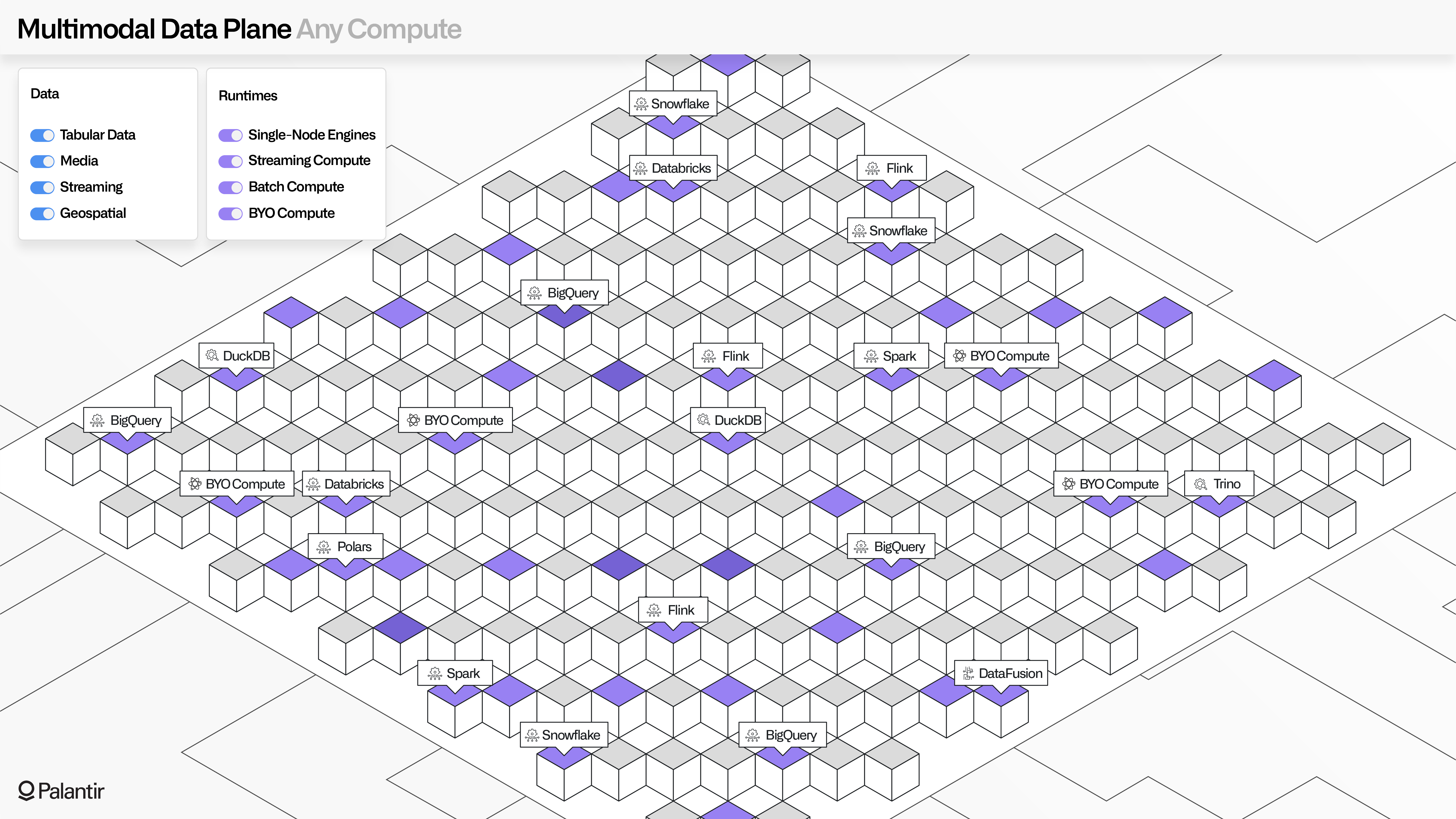 Illustration showing example compute engines supported by MMDP with title "Any Compute".
MMDP: Build with Any Compute
The Compute Modules framework enables a “Bring your own compute” (BYO Compute) model, allowing any containerized resource to be imported and securely surfaced through batch, streaming, or interactive functions.
Within operational workflows, critical executables and models are often siloed within legacy packages or domain-specific artifacts no longer actively developed. Compute Modules liberate these fragmented resources, enabling them to be securely hosted alongside modern logic artifacts (Python, Java, SQL, Go, Rust) in AI-enabled workflows.
Foundry and AIP can also orchestrate with compute resources outside the Palantir environment, including existing model inference infrastructure, external Spark clusters, cloud-hosted optimization engines, and on-premises high-performance computing (HPC). Additionally, MMDP supports native pushdown of compute to cloud-native runtimes like Databricks or Snowflake, allowing developers to use Pipeline Builder and Code Workspaces alongside their existing infrastructure.
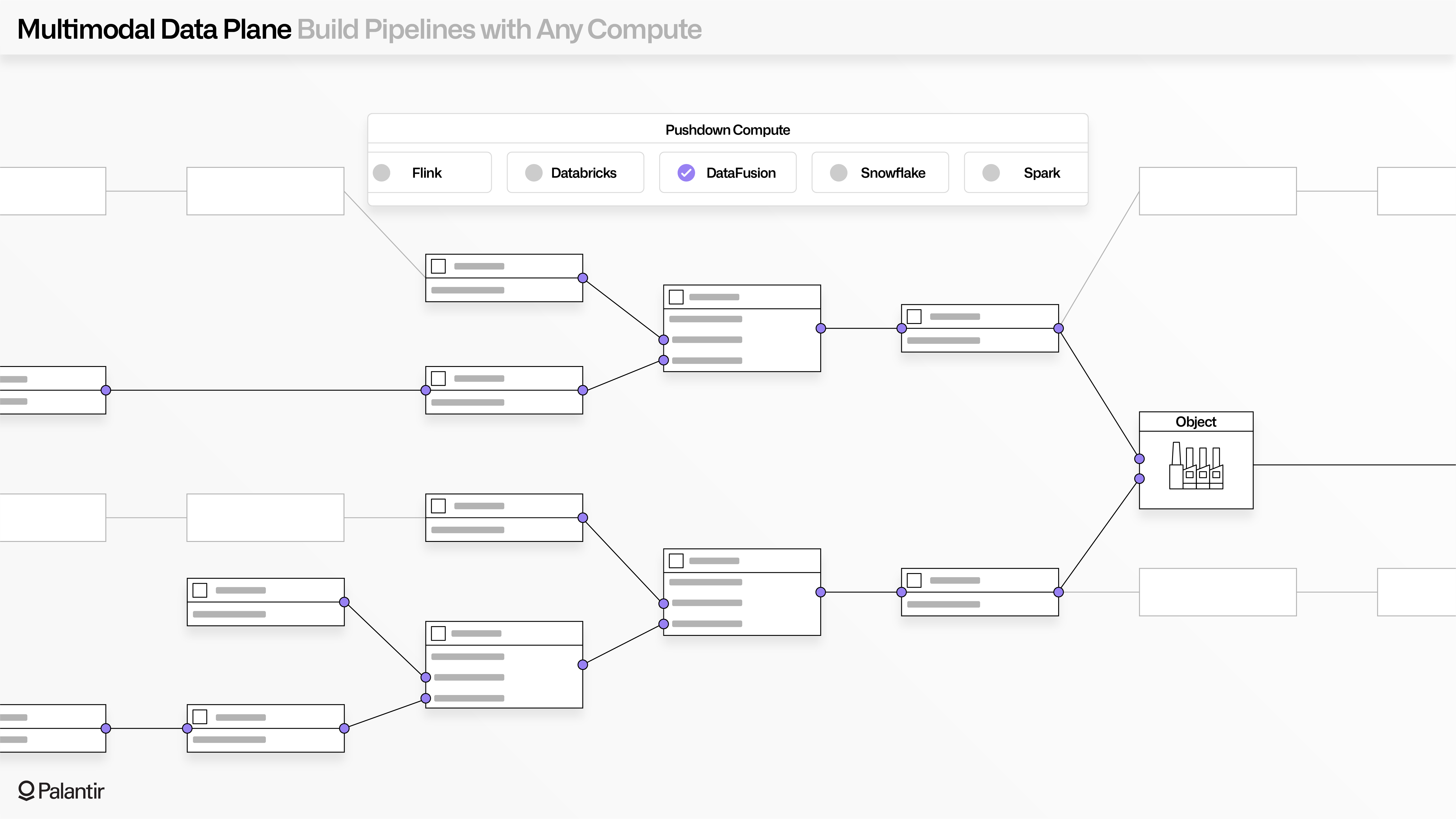 Illustration showing how compute resources can be connected with title "Build pipelines with Any Compute".
Any Model: Palantir's Commitment to Model Access
Palantir’s commitment to openness extends directly into generative AI. MMDP’s “any model” philosophy ensures the latest enterprise generative models are available via AIP’s Model Catalog—including offerings from OpenAI, Anthropic, Google, Meta, and xAI—while providing a completely level playing field for enterprises to register and deploy their own models equally.
LLMs and multimodal models, whether provided by Palantir or custom-registered, integrate seamlessly throughout Foundry and AIP applications across Pipeline Builder, Workshop, AIP Logic, and the broader developer toolchain. Administrators can govern model access with precision, setting token limits across all use-cases and lines of effort. Resource management capabilities extend cohesively across all data, compute, and AI models connected through MMDP, regardless of underlying modality, runtime, or format.
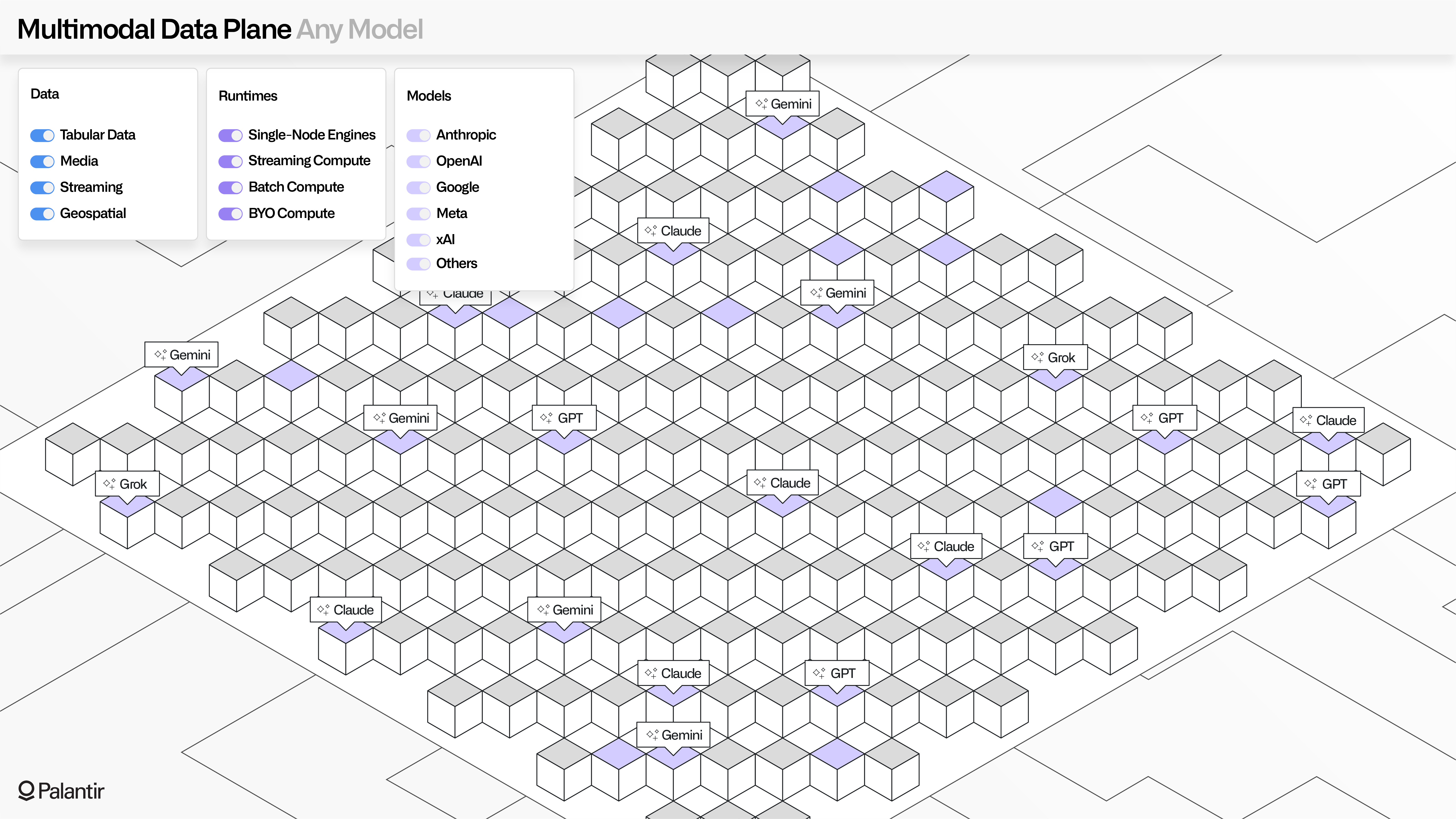 Illustration showing example models supported by MMDP with title "Any Model".
Anywhere: MMDP's Commitment to Openness
MMDP bridges the analytical and operational realms by deliberately resisting the limitations of monolithic storage and compute architectures. It combines an open data architecture leveraging Apache Iceberg with parity support for media, documents, streams, and multimodal types. Its compute architecture bundles standard runtimes while permitting teams to import external resources, offering rich interfaces to orchestrate existing enterprise infrastructure. This openness extends to generative AI through a vast Model Catalog and seamless custom model registration.
Through Palantir Apollo, all of this flexibility remains agnostic to the underlying infrastructure provider, continuously evolving in response to real-world demands encountered on operational frontlines.
MMDP’s core philosophy is encapsulated in a single directive: “Any data, any compute, any model, anywhere.”
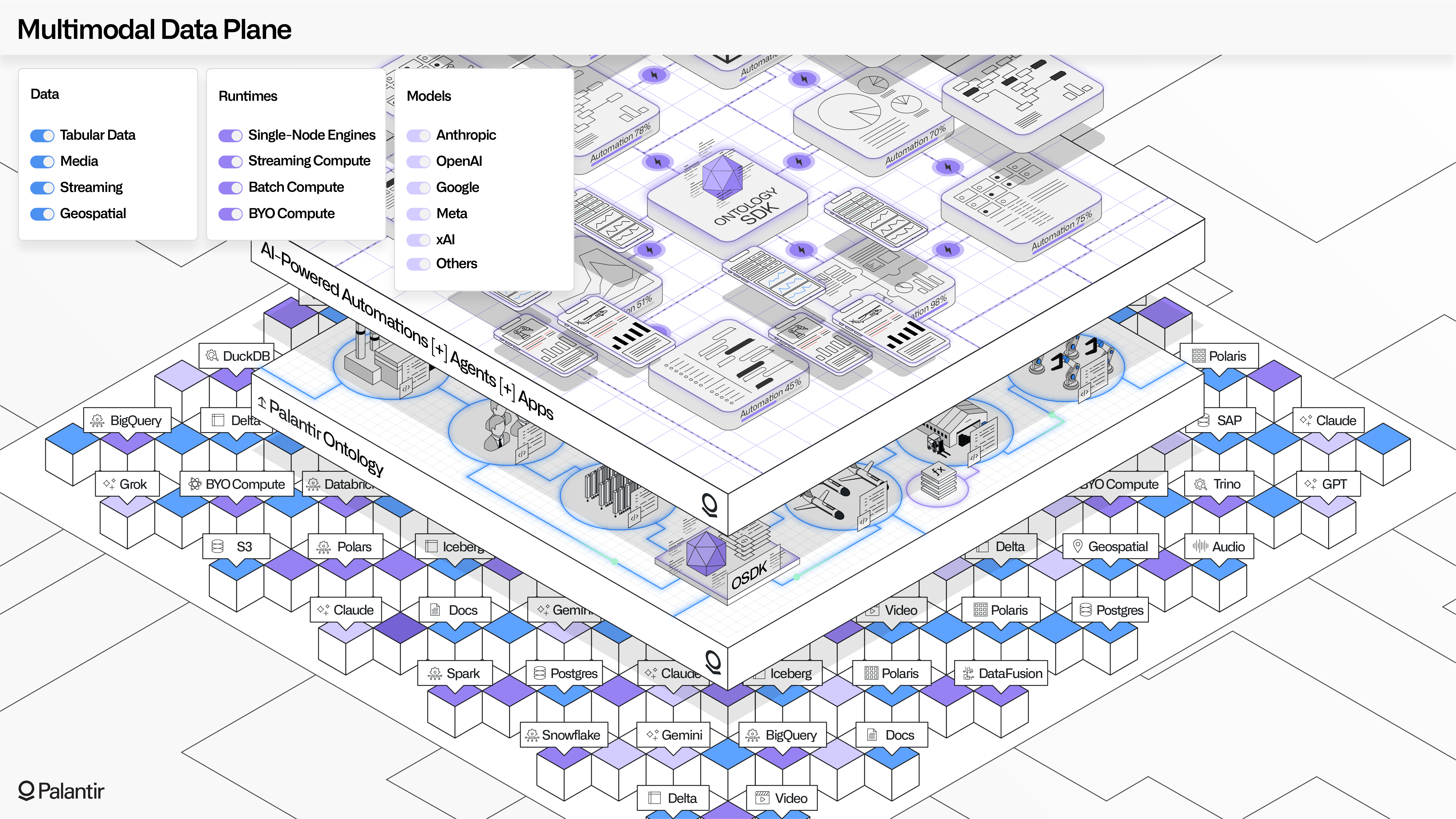 Illustration showing MMDP underlying the Ontology layer and the automations, agents, and apps layer.
Key Takeaways
- Apache Iceberg is the foundational table format, enabling catalog management, virtual tables, and zero-duplication workflows across Foundry and AIP while supporting external lakehouse and warehouse environments.
- Compute flexibility spans legacy to modern: Palantir Rubix provides a hardened, 72-hour-container-cycling Kubernetes mesh, while Compute Modules enable BYO compute, pushing workloads natively to Databricks, Snowflake, or existing on-prem/cloud infrastructure.
- Governance and optionality are baked in: Token limits, precise access controls, and unified resource management apply across all data modalities, compute runtimes, and AI models (including open/closed LLMs and custom enterprise models).
- Infrastructure agnosticism: MMDP deliberately avoids vendor lock-in through its “unwalled garden” approach, allowing Palantir to integrate seamlessly with any existing data mesh, AI mesh, or hybrid deployment model.
Learning map
Staged Roadmap
Stage 1: Fundamentals of MMDP
- Understand the core philosophy: Any Data, Any Compute, Any Model, anywhere
- Study Apache Iceberg's role in zero-distribution workflows
- Review MMDP architecture diagram (Any Data section)
Stage 2: Hands-on Architecture Design
- Build sample tables using Iceberg catalog management
- Deploy compute resources with Rubix/Kubernetes for batch/streaming workloads
- Test BYO Compute integration via Compute Modules framework
Stage 3: Generative Model Integration
- Register custom models in AIP's Model Catalog
- Implement token-based access controls for LLMs
- Explore pipeline automation with MMDP's unified toolchain
Get hands-on — step by step
- Create a simple Iceberg table using Databricks or Spark with sample tabular data.
- Register external catalogs from AWS S3, Google Cloud Storage, or Azure Blob Storage to the Iceberg catalog.
- Use SQL queries (e.g.,
SELECT * FROM) to validate cross-cloud data access. - Configure a compute module for streaming tasks using Flink templates via Palantir Rubix APIs.
- Register OpenAI's GPT-4 model in AIP as a test resource and verify API-driven inference workflows.
Top 3 sources
- 1Palantir Foundry Architecture Center - MMDP Documentation
Official documentation covering architecture principles, implementation patterns, and case studies for MMDP deployment.
https://www.palantir.com/docs/foundry/architecture-center/multimodal-data-plane/
- 2Apache Iceberg Project Documentation
Comprehensive resources for Iceberg table formats including schema evolution, storage integration, and query optimization guides.
https://iceberg.apache.org/docs/
- 3Databricks Lakehouse Integration Guide
Practical documentation to build unified data lakes using open standards that align with MMDP's storage architecture.
https://docs.databricks.com/lakehouse/index.html
Links are AI-suggested — worth a quick sanity check before diving in.