The Ontology system
7/29/2026, 9:15:43 PM · Source
Palantir’s Ontology system unifies fragmented enterprise data, logic, actions, and security into a single connected model that enables both humans and AI agents to make real-time operational decisions.
Palantir’s Ontology system is engineered to represent the complex, interconnected decisions of an enterprise rather than simply storing raw data. By tightly integrating data, logic, action, and security into a single operational backbone, it enables humans and AI agents to collaborate across fragmented systems, orchestrating workflows that bridge the digital and physical worlds.
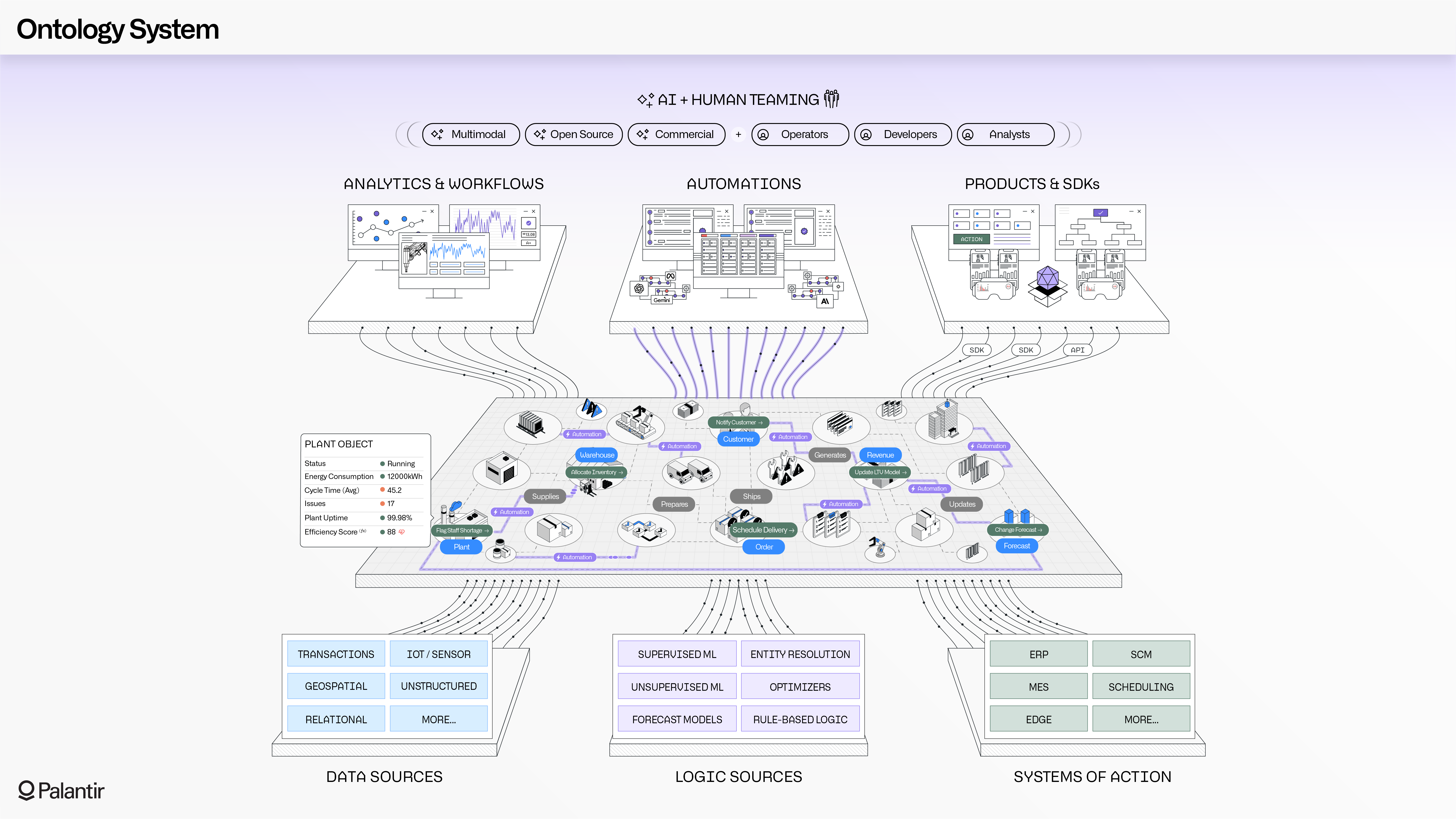 Diagram of how the Ontology connects data sources, logic sources, and systems and actions to analytics & workflows, automations, and products & SDKs.
Modeling Enterprise Decisions
Rather than acting as a passive repository, the Ontology functions as an active operational layer designed to unify disparate enterprise components into coherent workflows. Organizations across industries leverage this capability to bridge operational gaps:
- Aviation: Airlines model flights, aircraft fleets, crew manifests, and scheduling optimizers alongside fragmented enterprise assets to power day-of-flight operations and long-range strategic planning.
- Healthcare: Hospital systems map patients, nurse schedules, medical supplies, and bed capacities—elements that shift in real time—to drive the full patient lifecycle.
- Defense: Military organizations unify readiness information across forward-deployed forces with the operational processes behind reconnaissance and target selection, creating a shared operational world for multinational teams.
The Four-Fold Integration: Data, Logic, Action, and Security
The Ontology models decisions through the seamless integration of four core pillars. It ingests data from virtually every conceivable source (fragmented ERPs, homegrown record systems, CRMs, industrial databases, geospatial repositories, real-time sensors, document stores) and unifies them into coherent objects, properties, and links—the semantic concepts that enable stakeholders to interact with information.
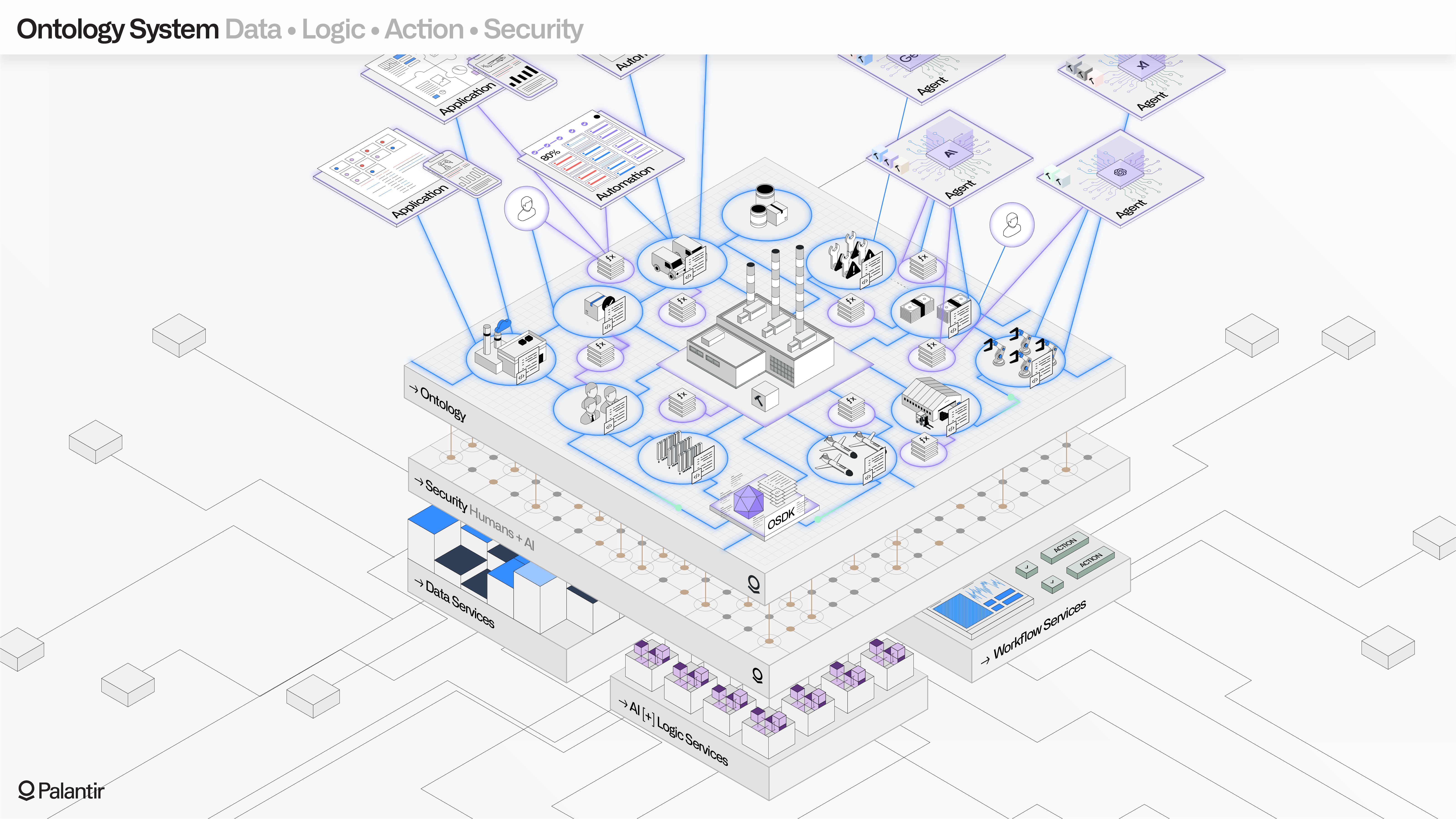 Diagram of how the Ontology is layered above a security layer, in turn above data, logic, and actions.
Data objects (the "nouns"), however, require "verbs" to model actual decisions; semantics must be paired with kinetics. This kinetic layer is defined by:
- Action: The Ontology models the full range of actions, from simple transactions to complex multi-step updates that must be written back to operational and edge systems in real time.
- Logic: The computational power driving each action is modular and evolvable. Logic can range from basic business rules and conventional machine learning models to LLM-driven functions or multi-step orchestrations across multiple compute engines.
- Security: Security is woven directly into data, logic, and actions rather than applied as an external layer. This ensures that every interaction—whether by a human user or an AI agent—is governed by precise, contextual permissions at the moment of execution.
Dynamic Security in Practice: Medical Manufacturing Scenario
To illustrate this architecture in action, consider a medical manufacturing company managing vendor interactions, production lines, logistics, and customer lifecycles. Their ontology models plants, work orders, customer details, inbound packages, and outbound shipments, integrating hundreds of underlying data sources. Access control adapts dynamically to different operational teams:
- Production teams require access to global telemetry pertaining to machines and the lifecycle of finished goods.
- Warehouse associates face granular restrictions tied to regional location and team assignment.
- Supply chain analysts operate under row/column-level restrictions targeting specific sensitive data elements per user.
When these teams build AI-powered agents, security scopes inherit directly from human users or predefined project permissions. This becomes highly complex when factoring in action and logic primitives connected to the Ontology. For example, triggering a purchase order may carry strict permissions, while running a scenario to gauge reallocation impacts might be more permissive. Similarly, underlying optimizers or LLM calls orchestrated via actions require entirely different security scopes. The Ontology’s architecture reconciles all of these granular policies at interaction time across tens of thousands of humans and agents.
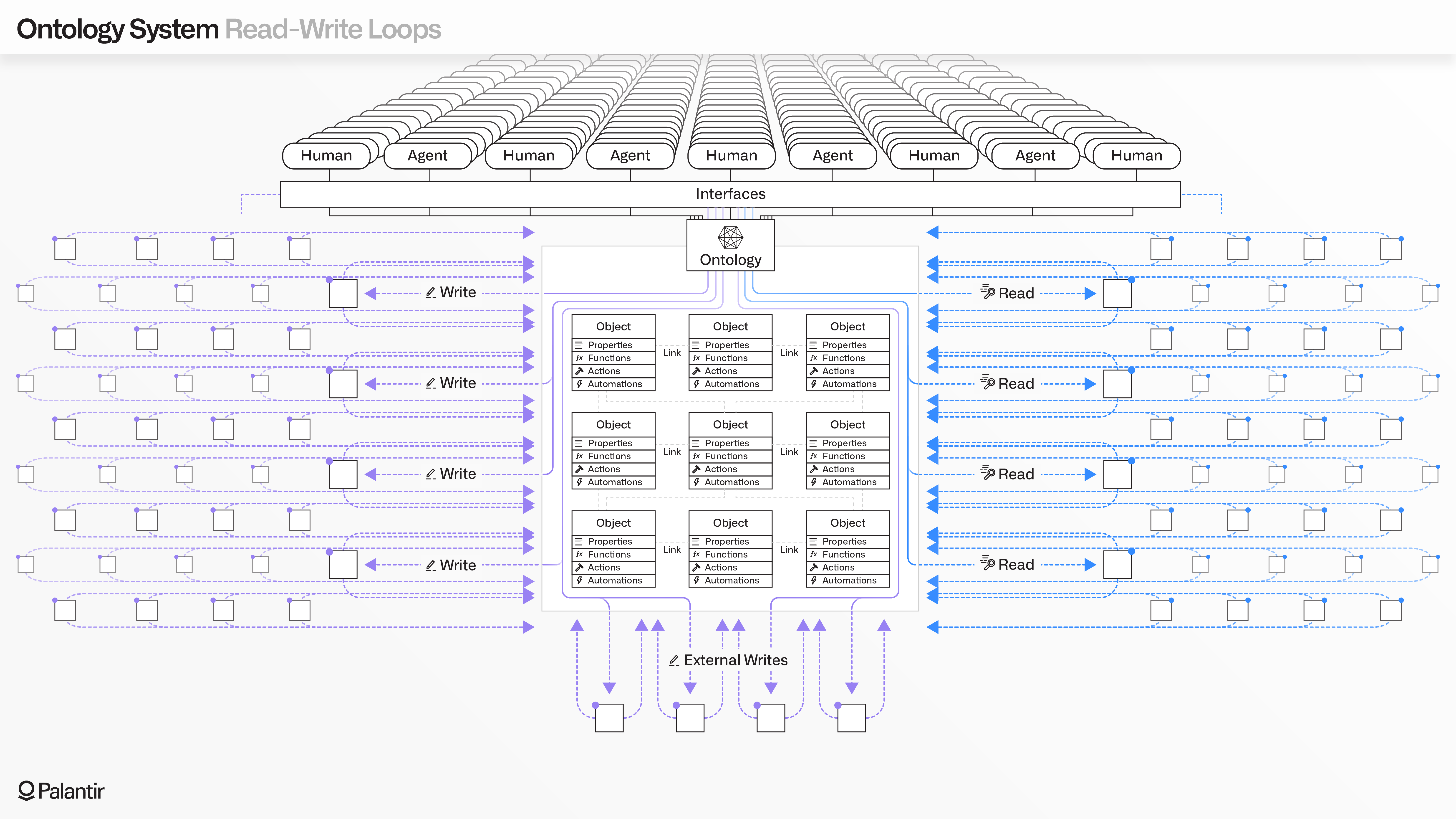 Diagram of how the Ontology enables read-write loops.
System Architecture: Language, Engine, and Toolchain
The Ontology is explicitly not a "semantic layer." The four-fold integration and operationalization of data, logic, action, and security cannot be achieved through a thin semantic overlay or a monolithic design. Instead, it operates as a multimodal system whose dozens of underlying components fall into three conceptual categories:
- Language: Models semantic objects, links, and properties, alongside kinetic actions and automations, and defines the exact logic that dictates how those actions operate and interact with external systems.
- Engine: Substantiates the Language by providing modular read architecture for high-scale SQL queries and real-time state change subscriptions, alongside a scalable write architecture enabling atomic/durable transactions, batch mutations, high-scale streams, and Change Data Capture for low-latency mirroring.
- Toolchain: Encompasses the full expressivity of the Language and power of the Engine, allowing developers to use the Ontology as a backend. This includes the Ontology SDK (OSDK) and a robust DevOps tooling suite designed for scaled production governance, powering AI-enabled applications in wildfire response, naval logistics, automotive assembly, and beyond.
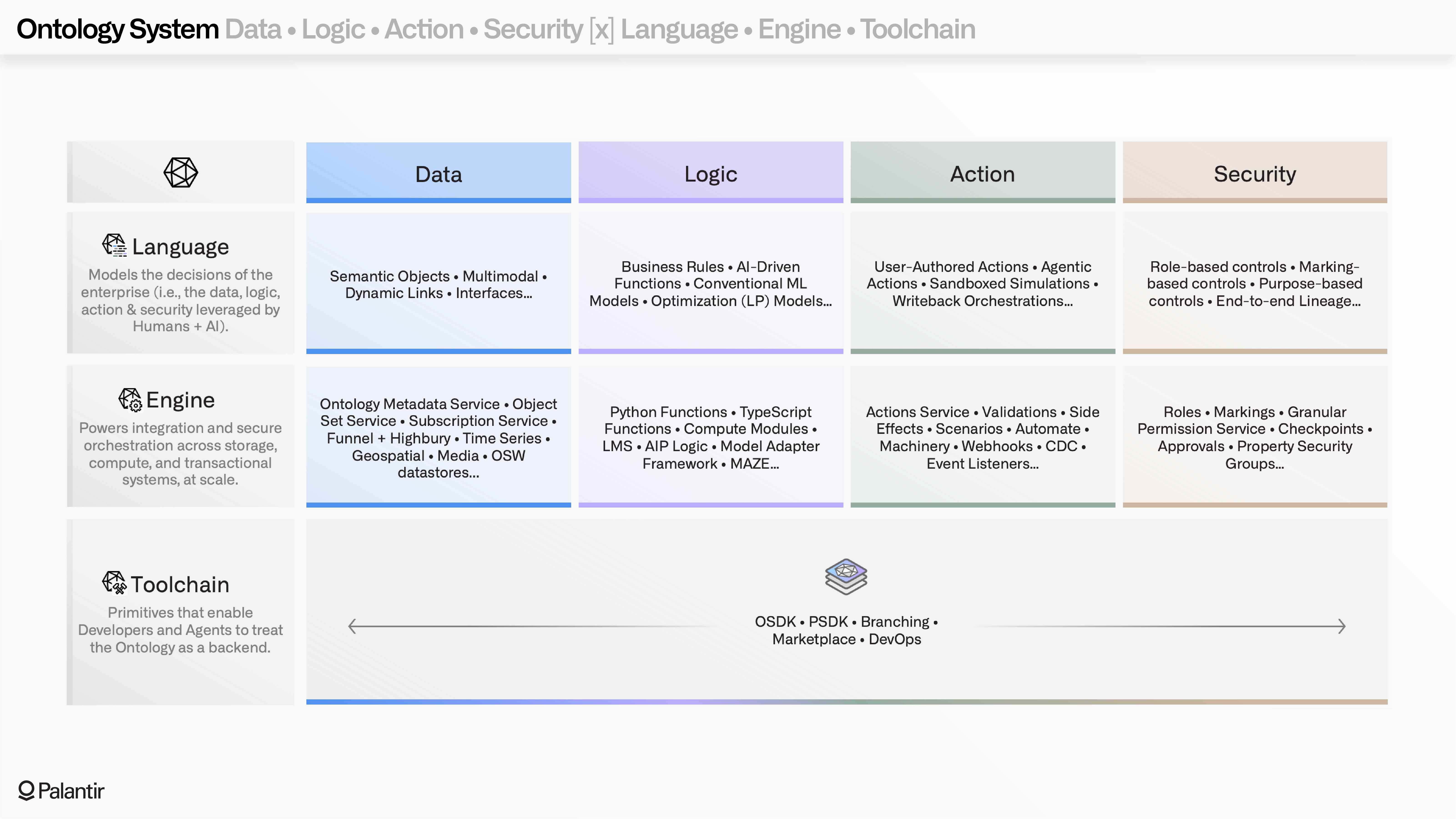 Table showing "Language", "Engine", and "Toolchain" as rows and "Data", "Logic", "Action", and "Security" as columns.
Building the Cybernetic Enterprise
The Ontology functions as a dynamic, compounding core for the cybernetic enterprise. Every data integration contributes to a high-fidelity operational representation shared by humans and AI agents. Every piece of logic can be connected to every action within a unified decision graph that bridges traditionally fragmented processes. Continuous feedback loops incorporate workflow data securely, accelerating the transition from augmentation to full automation.
Backed by battle-tested security and audit systems, the architecture ensures precise governance across an entire fleet of human and machine workers. The Ontology reflects the ambition of Palantir’s customers, with its constant evolution driven directly by their most critical missions.
Key takeaways
- Decision-focused modeling: The Ontology unifies enterprise data into actionable objects that explicitly model business decisions, not just information storage.
- Tightly integrated pillars: Data, logic, action, and security are woven together rather than layered separately, enabling real-time kinetic workflows.
- Granular, dynamic security: Access controls scale from row/column-level user restrictions to complex AI agent permissions, dynamically reconciling at interaction time.
- Comprehensive architecture: Built on a Language (semantics/logic), Engine (read/write scalability), and Toolchain (SDK/DevOps), it replaces monolithic designs with a modular multimodal system.
- Compounding operational impact: By connecting data to actions within secure decision graphs, organizations can accelerate workflows from human augmentation to autonomous automation.
Learning map
- Foundations of Enterprise Ontologies
- Understand the gap between raw data and operational decisions
- Explore Palantir's 4-pillar integration: Data, Logic, Action, Security
- Core Architecture & Layering
- Study the semantic objects, links, and kinetic actions (Language)
- Map modular read/write architectures for high-scale SQL and real-time subscriptions (Engine)
- Application & Toolchain Integration
- Learn to deploy the Ontology Software Development Kit (OSDK)
- Integrate LLM-driven functions, business rules, and optimization logic into decision graphs
- Advanced Governance & Scale
- Implement row/column-level security scopes for hybrid human/AI workflows
- Deploy continuous feedback loops and audit systems for production-grade automation
Get hands-on — step by step
- Map your target domain (e.g., airline operations, hospital scheduling) by listing core 'entities' and decision-making steps.
- Connect fragmented data sources to a unified graph using Ontology objects and properties.
- Attach modular logic rules or AI/ML models to each object based on specific decision requirements.
- Configure granular security scopes and permissions per user role and team function.
- Build a workflow by linking entities, logic, and actions into a cohesive operational cycle.
- Deploy the solution using the Ontology SDK (OSDK) and monitor the read-write loops for continuous improvement.
Top 3 sources
- 1Palantir Foundry Architecture Center: Ontology System
The official deep-dive into Palantir's four-fold integration architecture, covering language engine components and enterprise use cases.
https://www.palantir.com/docs/foundry/architecture-center/ontology-system/
- 2Palantir Ontology SDK (OSDK) Python
The official open-source development kit for building AI-enabled applications on top of the Palantir Ontology engine.
https://github.com/palantir/osdk-python
- 3Enterprise Knowledge Graphs: Design & Implementation
A foundational O'Reilly guide on modeling semantic objects, relationships, and security scopes for scalable AI and enterprise workflows.
https://www.oreilly.com/library/view/enterprise-knowledge-graph/9781492045648/
Links are AI-suggested — worth a quick sanity check before diving in.