Palantir Ontology ②: Four-Dimensional Integration
8/12/2026, 7:09:28 PM · updated 8/12/2026, 10:46:28 PM · Source
AI-translated on 8/12/2026, 10:51:06 PM · by Qwen3.6 35B (fast, default)
Deep analysis of how Palantir's Operational Ontology overcomes the knowledge description limitations of traditional semantic layers through a four-dimensional integrated model ("data, logic, operations, and security"), enabling transformation from concept graphs to real-time cybernetic enterprises.
Introduction: The End of the Kantian Dichotomy
Traditional philosophy features a classic distinction: epistemology (what we know) and praxis (what we ought to do). Kant wrote the Critique of Pure Reason and the Critique of Practical Reason separately, strictly separating the two.
Interestingly, traditional ontology fits squarely into this dichotomy—it deals only with "describing the world" (epistemology) and ignores "how to act upon the world" (praxis). The reasoning engine infers a new knowledge triplet, so what? Nothing more follows.
Palantir's four-dimensional integrated model essentially rejects this dichotomy. It unifies epistemology (data/logic) and praxis (manipulation/security) within a single architecture. How does it achieve this?
I. Core Definition: Three Theoretical Commitments
Palantir's official documentation defines Ontology as:
"The operational layer of an organization. In many scenarios, Ontology acts as a digital twin for the organization, containing semantic elements (objects, properties, links) and dynamic elements (actions, functions, dynamic security) to support various use cases."
This brief statement contains three key theoretical commitments: Commitment 1: Operational Layer, Not Representation Layer. Ontology is not a "metadata layer grafted onto a data warehouse," but rather "the operating system itself." It does not describe data; it instantiates data as actionable business objects. Commitment 2: Digital Twin, Not Conceptual Model. Ontology is not merely a conceptual specification but a real-time mirror of the organization's operating state. The concept of a digital twin proposed by Grieves (2014) is operationalized here: every Object instance in Ontology corresponds to an entity in the real world, and its property values update in real time as real-world events occur. Commitment 3: Unification of Semantics and Dynamics. Traditional ontology only has "nouns" (entities, properties, relationships); Palantir introduces "verbs" (Action Types, Functions), transforming the ontology from a static description into a dynamic system.
II. Four-Dimensional Integrated Model: Modeling Decisions Rather Than Modeling Data
Palantir's Architecture Center explicitly states that Ontology models decisions through the integration of four dimensions, rather than merely modeling data.
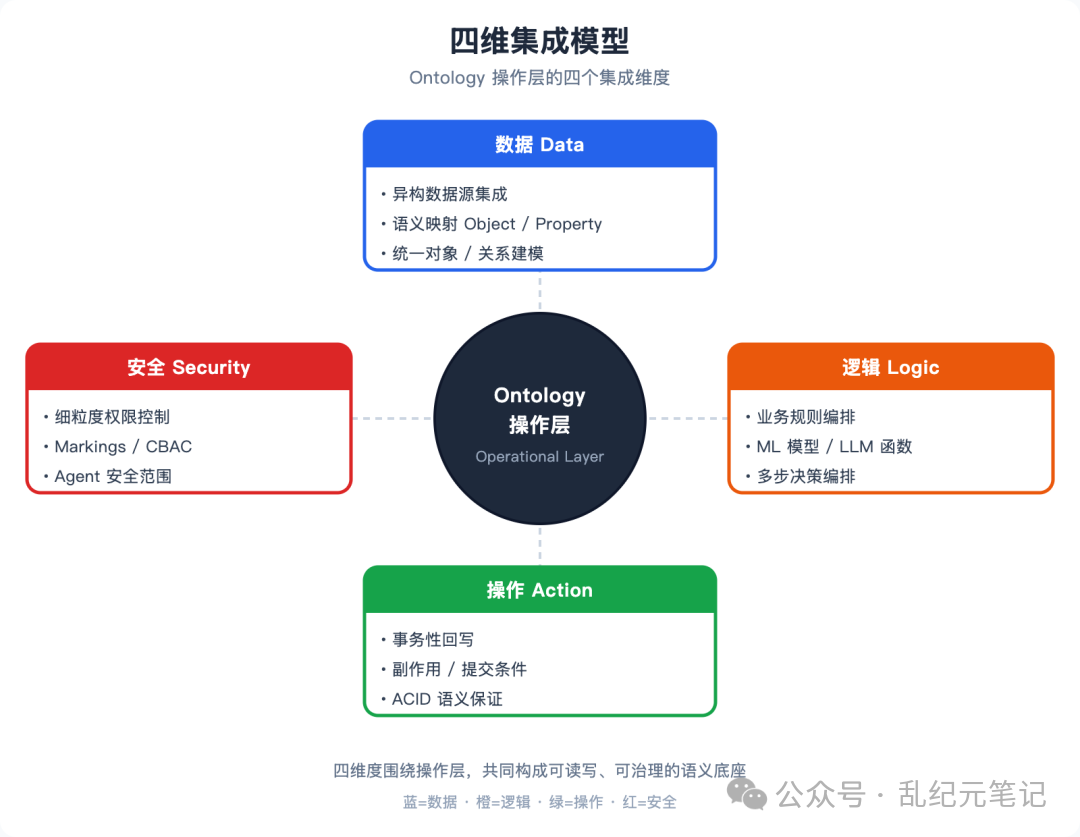 Dimension 1: Data
Data flows into Ontology from fragmented ERP assets, CRMs, industrial databases, geospatial repositories, real-time sensors, and document stores. Ontology unifies this heterogeneous data into coherent objects, properties, and links.
Unlike traditional data integration, Palantir's data integration is not a simple stacking of ETL pipelines, but instead performs semantic mapping through the Object Type's type system: each data source field is mapped to a Property of a specific Object Type, and the mapping relationships themselves are governed and version-controlled.
For example: an "Employee" Object Type might simultaneously integrate data from an HR system (hire date), a payroll system (pay grade), and an access control system (last clock-in time). While mutually unrelated in their respective source systems, this data is unified in Ontology into a single business object with identity, relationships, and actionable capabilities.
Dimension 2: Logic
The logic powering each operation is modular and evolvable. The logic can be:
• Simple business rules ("trigger replenishment when inventory falls below threshold")
• Traditional machine learning models (demand predictors)
• LLM-driven functions (conversions from natural language to structured operations)
• Complex multi-step orchestration involving multiple computation engines
The key point is: Logic is not hardcoded into applications but managed as a first-class citizen within Ontology. Functions have version control, access management, and monitoring telemetry, decoupled from application code.
This means the same predictive model can be invoked by multiple applications, and updating the model requires no changes to any application code—only publishing a new version within Ontology.
Dimension 3: Action
Data objects ("nouns") must be supplemented by "verbs" to model decisions. The definition of an Action Type includes:
• Parameter definitions: standardized forms for user input
• Change rules: how properties of which objects are modified
• Side effects (Side Effects): notifications and Webhook calls triggered upon submission of the action
• Submission criteria (Submission Criteria): prerequisite validation for the action to take effect
An Action is defined as "a single transaction that changes one or more object properties." Notice the word "transaction"—this brings database ACID semantics into ontology, a concept entirely absent from traditional ontology.
After traditional ontology infers a new triplet, it merely "exists," with no rollback, no side effects, and no prerequisite validation. In contrast, for Palantir's Action Type, every operation has a clear schema, permissions, and audit trail; failures can be rolled back, and successes trigger downstream effects.
Dimension 4: Security
Security is woven into the three dimensions of data, logic, and action. The system must coordinate fine-grained policies spanning potentially tens of thousands of humans and agents at the time of interaction.
Permissions can vary finely: triggering a purchase order might require strict permissions, running scenario analysis might be more relaxed, and underlying optimizers or LLM calls might have "completely different security scopes." AI-driven Agents must possess a security scope that "inherits from human users or from the permission structures of defined projects."
The theoretical significance of this four-dimensional integration lies in its rejection of the Kantian dichotomy of "separation of knowledge and action" in traditional ontology, unifying epistemology (data/logic) and praxis (manipulation/security) within a single architecture.
Dimension 1: Data
Data flows into Ontology from fragmented ERP assets, CRMs, industrial databases, geospatial repositories, real-time sensors, and document stores. Ontology unifies this heterogeneous data into coherent objects, properties, and links.
Unlike traditional data integration, Palantir's data integration is not a simple stacking of ETL pipelines, but instead performs semantic mapping through the Object Type's type system: each data source field is mapped to a Property of a specific Object Type, and the mapping relationships themselves are governed and version-controlled.
For example: an "Employee" Object Type might simultaneously integrate data from an HR system (hire date), a payroll system (pay grade), and an access control system (last clock-in time). While mutually unrelated in their respective source systems, this data is unified in Ontology into a single business object with identity, relationships, and actionable capabilities.
Dimension 2: Logic
The logic powering each operation is modular and evolvable. The logic can be:
• Simple business rules ("trigger replenishment when inventory falls below threshold")
• Traditional machine learning models (demand predictors)
• LLM-driven functions (conversions from natural language to structured operations)
• Complex multi-step orchestration involving multiple computation engines
The key point is: Logic is not hardcoded into applications but managed as a first-class citizen within Ontology. Functions have version control, access management, and monitoring telemetry, decoupled from application code.
This means the same predictive model can be invoked by multiple applications, and updating the model requires no changes to any application code—only publishing a new version within Ontology.
Dimension 3: Action
Data objects ("nouns") must be supplemented by "verbs" to model decisions. The definition of an Action Type includes:
• Parameter definitions: standardized forms for user input
• Change rules: how properties of which objects are modified
• Side effects (Side Effects): notifications and Webhook calls triggered upon submission of the action
• Submission criteria (Submission Criteria): prerequisite validation for the action to take effect
An Action is defined as "a single transaction that changes one or more object properties." Notice the word "transaction"—this brings database ACID semantics into ontology, a concept entirely absent from traditional ontology.
After traditional ontology infers a new triplet, it merely "exists," with no rollback, no side effects, and no prerequisite validation. In contrast, for Palantir's Action Type, every operation has a clear schema, permissions, and audit trail; failures can be rolled back, and successes trigger downstream effects.
Dimension 4: Security
Security is woven into the three dimensions of data, logic, and action. The system must coordinate fine-grained policies spanning potentially tens of thousands of humans and agents at the time of interaction.
Permissions can vary finely: triggering a purchase order might require strict permissions, running scenario analysis might be more relaxed, and underlying optimizers or LLM calls might have "completely different security scopes." AI-driven Agents must possess a security scope that "inherits from human users or from the permission structures of defined projects."
The theoretical significance of this four-dimensional integration lies in its rejection of the Kantian dichotomy of "separation of knowledge and action" in traditional ontology, unifying epistemology (data/logic) and praxis (manipulation/security) within a single architecture.
III. Three-Part Breakdown: Language—Engine—Toolchain
Beyond the four-dimensional integration, Palantir also decomposes the Ontology system into three layers, offering a complementary perspective. Language (Language Layer) Language models semantic objects, links, and properties, as well as dynamic operations and automation. Traditional OWL defines Classes, Properties, and Individuals; Palantir Language defines Object Types, Link Types, Action Types, Functions, and Interfaces. The key difference lies in Action Types and Functions: they encode operational semantics and computational logic as part of the type system, allowing operations to be defined, inherited, constrained, and governed just like classes. This is not merely adding a few keywords to a type system, but rather granting "operations" typological status equal to that of "concepts." Engine (Engine Layer) The Engine instantiates every component of the Language, providing: • Read architecture: supports large-scale SQL queries, real-time state subscriptions, and various materializations required by human-AI hybrid teams • Write architecture: supports atomic and durable transaction updates, large-scale batch changes, and low-latency mirroring mechanisms like Change Data Capture Reasoning engines in traditional ontology (such as Pellet, HermiT) only generate new knowledge assertions—"inferring that A is a subclass of B." The Palantir Engine, however, executes real transactional write operations and synchronizes changes to external systems—"assigning employee A to project B, updating related links, triggering notifications, and syncing to the HR system." Toolchain (Toolchain Layer) The Toolchain enables developers to use Ontology as a backend, including:
• OSDK: Strongly-typed SDK supporting TypeScript, Python, and Java, generated directly from Ontology metadata • Workshop: No-code application builder with native read/write access to Ontology • AIP Logic: Functions written back to Ontology • Object Views / Object Explorer / Quiver: Analysis tools
IV. Semantic – Kinetic – Dynamic: Another Perspective
Some analytical literature categorizes the Palantir Ontology architecture into three layers, which complements the previously mentioned tripartite decomposition: • Semantic Layer – What the world is: Defines domain concept models and establishes a shared language across teams. Harmonizes fragmented data concepts (e.g., "user," "customer," "individual") into a unified Person entity. • Kinetic Layer – How to act upon the world: Includes data mapping, ETL pipelines, and data lineage. Defines operational semantics through Action Types, transforming Ontology from a "conceptual graph" into an "executable system." • Dynamic Layer – How to govern evolution: Includes business rules, access control, and lifecycle management, ensuring governance consistency as Ontology continuously evolves.
If the four-dimensional integration model is viewed as a "static snapshot" (all four dimensions existing simultaneously), then this three-layer architecture serves as a "dynamic perspective" (a progression from semantics to kinetics to governance). Both describe the same system, merely from different viewpoints.
V. The Read-Write Loop: The Heart of the Cybernetic Enterprise
The core operational mode of Ontology is a continuous read-write loop:

- Read: Data integration constructs a "complete, high-fidelity representation of the operational world, shared by humans and AI Agents."
- Logic: Simple rules or multi-step orchestrations are connected to actions, forming a "decision graph that ties traditionally fragmented processes together."
- Write: Actions are written back to Ontology and external systems.
- Feedback: Feedback collected within workflows "is securely fed into a continuous learning loop," driving evolution from augmentation to automation.
- Governance: Security and audit systems ensure that "every activity can be precisely governed, covering the entire workforce of humans and machines."
This loop forms what Palantir calls a cybernetic enterprise — a closed-loop system that is self-perceiving, self-deciding, self-executing, and self-learning.
In contrast to the linear interaction of traditional ontologies—Query → Reasoning → Return Result—Palantir's cyclic interaction is: Query → Decision → Action → Feedback → Learning → Re-query. The former is a one-time knowledge retrieval, while the latter represents continuous operational decision-making.
VI. Essential Difference from Semantic Layers
Understanding the four-dimensional integration and the read-write loop clarifies the emphasized statement at the core of Palantir's architecture:
"Ontology is not a 'semantic layer'." Semantic layers (such as dbt Semantic Layer, Snowflake Semantic Views, Cube, AtScale) define how metrics are measured: how revenue is calculated, how active users are defined. At their core, they are SQL generation layers that translate business metric definitions into executable queries.
Atlan's analysis succinctly captures the distinction between the two:
"A semantic layer defines how revenue is measured; an ontology defines what a customer is, and how it connects across systems." | Dimension | Semantic Layer | Palantir Ontology | |---|---|---| | Core Question | How metrics are calculated | What entities are, and how they can be operated on | | Data Model | Dimension/Metric model | Object/Link/Action model | | Read/Write Capability | Read-only (generates SQL) | Bidirectional read/write (transactional writes-back) | | Governance | Metric definition governance | Four-dimensional governance (Data / Logic / Action / Security) | | AI Readiness | Low (metric retrieval only) | High (OAG semantic anchoring) | | Architectural Positioning | Thin layer atop data warehouses | Multi-modal operating system |
Palantir's argument is that four-dimensional integration "cannot be achieved through a thin semantic layer or a monolithic design"; Ontology is a "multi-modal system composed of dozens of underlying components."
Summary of This Article
To summarize the core innovation of Palantir's theoretical framework in one sentence:
Traditional ontology is the "world of nouns"—defining concepts and relationships; Palantir's operational ontology is the "world of nouns + verbs"—not only defining concepts, but also defining how those concepts can be operated on, and the governance boundaries of those operations.
The four-dimensional integration model (Data-Logic-Action-Security) provides the static architecture, the read-write loop offers the dynamic operational mode, and the tripartite decomposition (Language-Engine-Toolchain) supplies the engineering implementation framework. Together, they form a complete theoretical system.
Yet this all remains at the theoretical level. How does Palantir translate this theory into a functioning engineering system? What exactly are the specific designs for the five major building blocks and the microservices backend architecture?
Learning map
Stage One: Theoretical Foundation —— The Essential Difference Between Ontology and the Semantic Layer
- Understand the ontological distinction between "nouns" and "verbs" (static description vs. dynamic intervention).
- Analyze the read-only limitations of traditional semantic layers (e.g., dbt/Snowflake Views).
Stage Two: Deconstructing the Four-Dimensional Integrated Architecture
- Data Dimension: Semantic mapping of Object Types for heterogeneous data.
- Logic Dimension: Management of Functions and business rules.
- Operation Dimension: Transactional definition of Action Types and ACID support.
- Security Dimension: Fine-grained subject access control (ACL) and security scope inheritance.
Stage Three: The Dynamic Cybernetic Enterprise
- Study the closed-loop mechanism of the "continuous read-write loop" (Read-Logic-Write-Feedback-Learn).
- Learn how to seamlessly weave Agents and human workflows into the operational cycle.
Stage Four: Engineering Implementation Framework (Language—Engine—Toolchain)
- Language Layer: Define Object, Link, Action, Function.
- Engine Layer: Handle write architecture, CDC synchronization, and real-time state subscriptions.
- Toolchain: Build applications using Workshop and the OS SDK.
Get hands-on — step by step
- Access the Object Explorer workspace in Palantir AIP (Artificial Intelligence Platform).
- In Object Explorer, create a new Object Type (e.g., define an object named 'Supplier') via the Schema panel, and add Properties to it (e.g., Supplier ID, Address, Rating).
- Use the Workshop to create a corresponding Action Type (e.g., 'Update Supplier Rating'): configure the parameter list, and bind a Function to the action in the Logic tab.
- On the connected data source (e.g., an external relational database or SQL Warehouse), configure a Data Link for the Object to achieve real-time read mapping.
- Click "Test" to run the Action Type, observe the execution logs of the underlying read-write loop, and verify the response of the feedback mechanism.
Top 3 sources
- 1Official AIP Documentation: Introduction to Ontology
Palantir 官方架构中心文档,详细解释了本体论作为组织'操作层(Operational Layer)'的核心定义与理论承诺。
https://www.palantir.com/docs/aip/foundry/introduction-to-ontology/
- 2Official AIP Documentation: Building Action Types
官方操作指南,深入探讨如何将业务规则、函数与安全边界封装为 Action Type 以支持事务性干预。
https://www.palantir.com/docs/aip/aip-logic/build-action-types/
- 3Palantir & Databricks: The Operational Knowledge Graph
深入分析如何构建支持 AI Agent 与人类操作无缝协作的连续读写回路与控制论架构。
https://www.palantir.com/blog/how-palantirs-operational-knowledge-graph-works/
Links are AI-suggested — worth a quick sanity check before diving in.