Transformers: Attention is all you need
7/20/2026, 1:58:41 PM · Source
The 2017 'Attention Is All You Need' paper revolutionized natural language processing by replacing recurrent and convolutional networks with a highly parallelizable self-attention mechanism, forming the foundation of modern Large Language Models.
Published in 2017 by Google researchers, the seminal research paper "Attention is All You Need" introduced the Transformer, a revolutionary neural network architecture that completely transformed the field of natural language processing (NLP). By replacing traditional recurrent and convolutional networks with an entirely attention-based mechanism, this architecture laid the foundation for the modern Large Language Models (LLMs) we use today, such as GPT and PaLM.
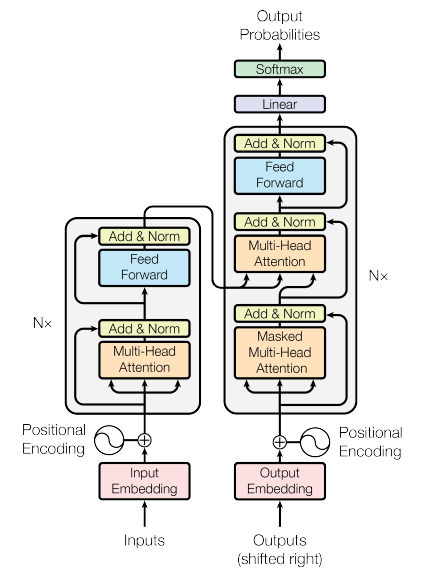 Transformers architecture diagram
Paradigm Shift: Replacing RNNs and CNNs
Prior to the Transformer, sequence modeling and transduction tasks heavily relied on recurrent neural networks (RNNs) or convolutional neural networks (CNNs). The Transformer model discards these architectures in favor of a novel self-attention mechanism.
This shift provides two major advantages:
- Long-term dependencies: Self-attention allows the model to connect distant words in a sequence directly, making it highly effective at capturing context.
- Parallelized computation: Unlike RNNs, which process tokens sequentially, the Transformer processes entire sequences simultaneously, significantly improving training efficiency and speed.
The Transformer Architecture
The Transformer follows a classic encoder-decoder structure, where both the encoder and decoder are composed of a stack of multiple identical layers. Each of these layers contains two primary sub-layers:
1. Multi-Head Self-Attention
This mechanism allows the model to dynamically attend to different parts of the input sequence at the same time. Rather than performing a single attention function, "multi-head" attention runs multiple attention processes (heads) in parallel, allowing the model to jointly attend to information from different representation subspaces at different positions.
2. Position-Wise Feed-Forward Networks
Applied to each position separately and identically, this sub-layer consists of a point-wise fully connected neural network that processes the output of the attention mechanism.
Optimization and Training Enhancements
To facilitate deep architecture training and prevent overfitting, the network incorporates:
- Residual Connections: Added around each of the sub-layers.
- Layer Normalization: Applied after the residual connections to stabilize training.
- Positional Encoding: Because the model lacks recurrent or convolutional operations, it has no inherent sense of sequence order. The authors introduced positional encodings—added to the input embeddings—to inject information about the relative or absolute position of tokens in the sequence.
Legacy and Impact
In their paper, the authors demonstrated that the Transformer achieved state-of-the-art (SOTA) performance on multiple machine translation benchmarks, outperforming previous models while requiring significantly less time to train. Today, this architecture serves as the underlying engine powering nearly all modern generative AI and LLM breakthroughs.
To dive deeper into the technical specifications, you can read the original research paper here: Attention Is All You Need.
Key Takeaways
- Eliminated Recurrence: The Transformer replaced sequential processing (RNNs/CNNs) entirely with a self-attention mechanism, enabling massive parallelization.
- State-of-the-Art Performance: Upon release, it set new benchmarks in machine translation with significantly faster training times.
- Multi-Head Attention: This core mechanism allows the model to focus on different aspects and positions of the input sequence simultaneously.
- Positional Encoding: Added spatial context directly to the input embeddings, preserving token order without needing sequential operations.
- Foundation of Modern LLMs: This architecture is the direct predecessor of today’s leading AI models, including GPT, PaLM, and other transformer-based systems.
Learning map
Stage 1: Core Concepts
- Sequence-to-Sequence Modeling: Understand why traditional RNNs and LSTMs struggle with long-range dependencies and parallelization.
- Self-Attention Mechanism: Learn how Scaled Dot-Product Attention calculates representation weights based on Queries, Keys, and Values.
Stage 2: Architecture Details
- Multi-Head Attention: Grasp how splitting attention into multiple 'heads' allows the model to jointly attend to information from different representation subspaces.
- Positional Encoding: Study how order is injected into the word embeddings using sine and cosine functions since Transformers lack recurrence.
- Feed-Forward Networks & LayerNorm: Understand the pointwise post-processing, residual connections, and normalization that stabilize training.
Stage 3: Implementation & Scaling
- Encoder-Decoder vs. Decoder-Only: Compare the original translation model with modern decoder-only variants (like GPT) and encoder-only variants (like BERT).
- Building from Scratch: Implement a basic multi-head attention block in PyTorch to solidify theoretical understanding.
Get hands-on — step by step
Step 1: Install Dependencies
First, install PyTorch and the Hugging Face Transformers library to run your first Transformer model.
pip install torch transformers
Step 2: Implement Scaled Dot-Product Attention in Python
Write a simple function in PyTorch to compute self-attention manually, helping you understand the Query, Key, and Value matrix multiplications.
import torch
import torch.nn.functional as F

def scaled_dot_product_attention(q, k, v):
    d_k = q.size(-1)
    scores = torch.matmul(q, k.transpose(-2, -1)) / torch.sqrt(torch.tensor(d_k, dtype=torch.float32))
    weights = F.softmax(scores, dim=-1)
    return torch.matmul(weights, v), weights

# Test with dummy query, key, value tensors
q = k = v = torch.rand(1, 4, 64)
output, weights = scaled_dot_product_attention(q, k, v)
print("Output shape:", output.shape)
print("Attention Weights shape:", weights.shape)
Step 3: Run a Pre-trained Transformer Pipeline
Use Hugging Face's pipeline API to load a pre-trained Transformer model and run sequence generation to see the architecture in action.
from transformers import pipeline

generator = pipeline("text-generation", model="gpt2")
result = generator("Attention mechanisms revolutionized AI because", max_length=30, num_return_sequences=1)
print(result[0]['generated_text'])
Top 3 sources
- 1Attention Is All You Need Paper
The original groundbreaking research paper by Vaswani et al. introducing the Transformer architecture.
https://arxiv.org/abs/1706.03762
- 2The Illustrated Transformer by Jay Alammar
An exceptionally visual and intuitive breakdown of how the Transformer and its self-attention mechanism work.
https://jalammar.github.io/illustrated-transformer/
- 3The Annotated Transformer by Harvard NLP
A line-by-line PyTorch implementation and explanation of the entire Transformer paper.
https://nlp.seas.harvard.edu/2018/04/03/attention.html
Links are AI-suggested — worth a quick sanity check before diving in.