The AI platform that takes you from prototype to production.
7/20/2026, 11:01:55 PM · Source
Palantir AIP accelerates the development of production-grade AI applications by integrating enterprise data through a semantic Ontology, offering auto-generated SDKs, and scaling containerized workloads.
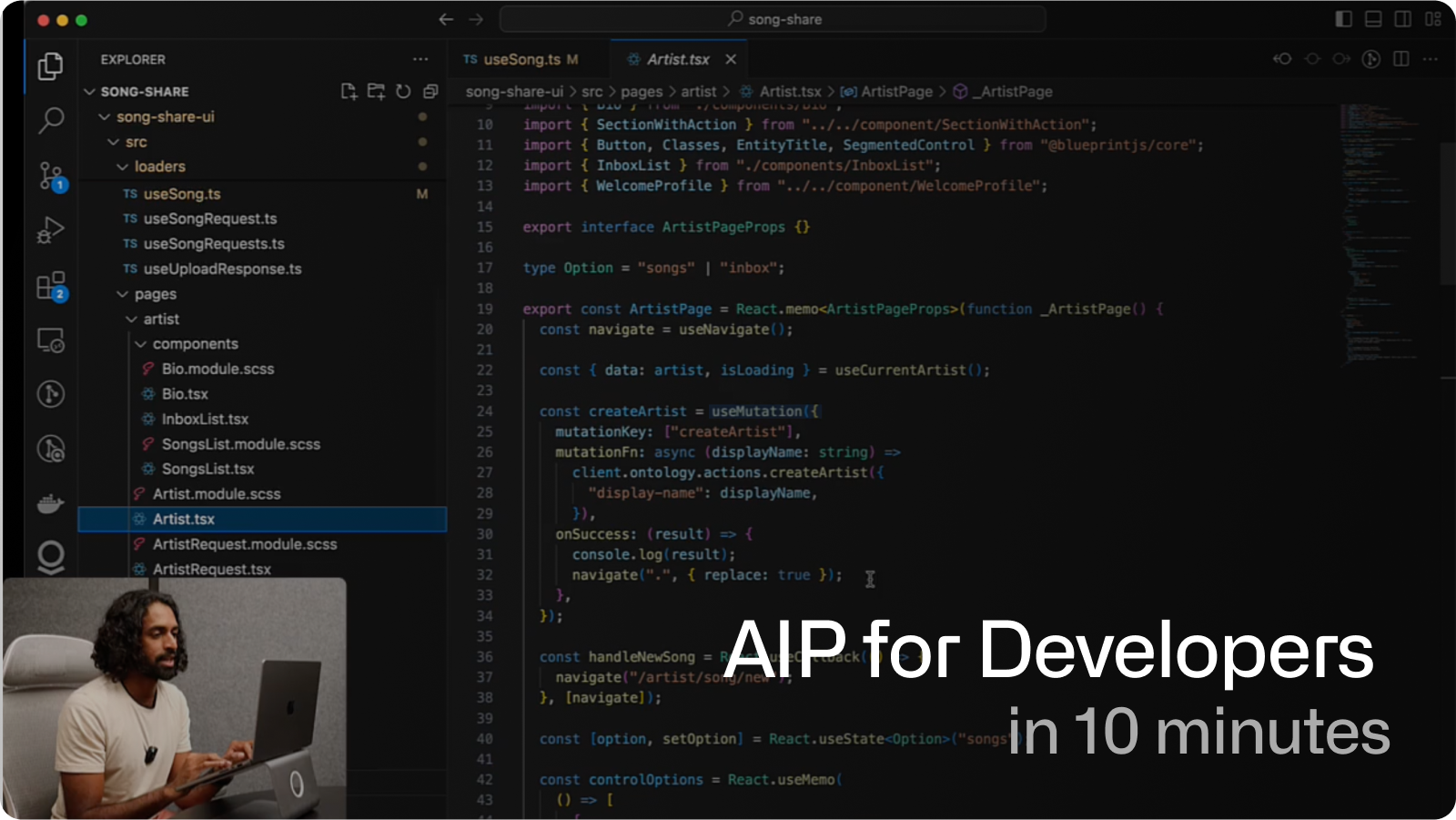 Play Now. AIP Developer Platform
Palantir's Artificial Intelligence Platform (AIP) is an enterprise-grade developer platform designed to accelerate software engineering from prototype to production in hours. By providing a unified operational data model, extensible compute options, and robust LLM development tooling, AIP handles the underlying backend infrastructure, security, and scaling so developers can focus on delivering customer value.
The Ontology SDK: Deprecating the Backend
While hyperscalers deprecated physical infrastructure by moving it to the cloud, AIP deprecates backend complexity by allowing developers to define their operational data model directly in AIP’s Ontology. Once defined, AIP automatically generates a custom, production-ready SDK for your business.
The Ontology SDK provides a suite of tools and libraries that simplify building applications on top of your Ontology, offering several key advantages:
- Incredible Speed to Value: Rapidly build applications using a pre-configured SDK that mirrors your real-world operations.
- Code Generation for Common Tasks: The SDK automatically generates boilerplate code for standard data interactions, saving developer time and minimizing the risk of errors.
- A Familiar Developer Environment: Designed to align with standard development practices, reducing the learning curve and maximizing developer productivity.
- Build in Any Language: The SDK is available as an NPM package for TypeScript, via Pip or Conda for Python, or through an OpenAPI specification for any other language of choice.
- Powered by the Ontology: Engage with enterprise data using standard, intuitive business terms shared across all of your organization's development teams.
- Auto-generated Documentation: Start writing code immediately with custom-generated documentation and code examples tailored specifically to your defined Ontology.
Developer Resources
Explore the following resources to learn more and get started:
- Join the Community: Ask questions and collaborate with other developers in the Palantir Developer Community.
- Read the Documentation: Learn how the Ontology SDK works by visiting the Ontology SDK Overview Documentation.
Modular and Interoperable Architecture
AIP is designed to be fully interoperable across your entire technology stack. It connects seamlessly to any source system, accepts any containerized code, and supports custom front-end development.
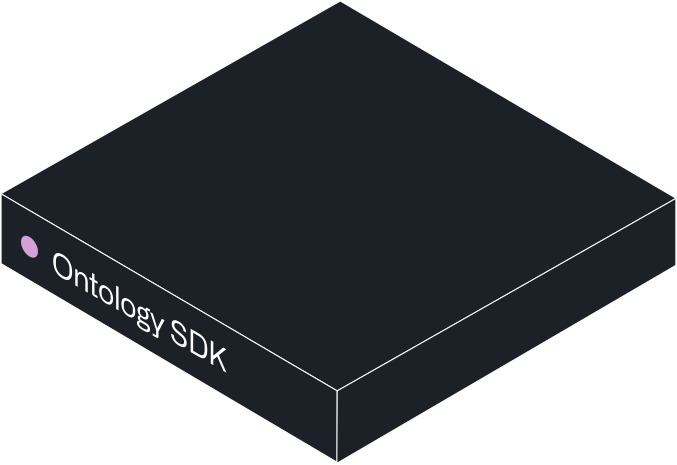 Ontology SDK Stack
Full-Stack Customization
The Ontology SDK enables pro-code builders to build custom applications without arbitrary limitations, in any programming language, and within any development environment.
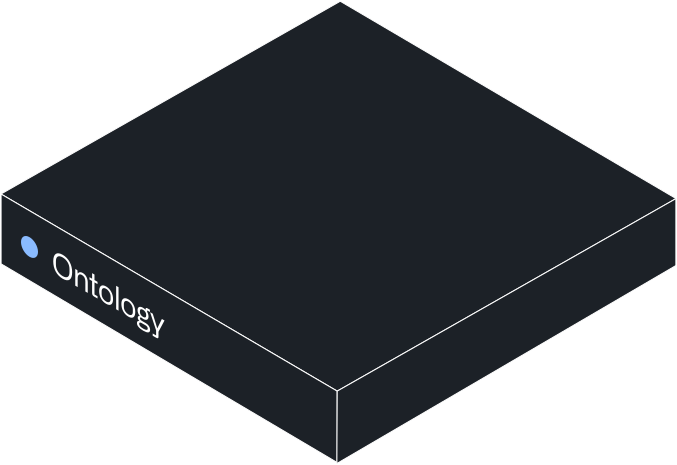 The Core Ontology
Unified API Endpoint
The Ontology creates a clean API enabling you to build operational applications on top of any underlying data, modeling, or systems of action. No-code builders can leverage AIP’s intuitive drag-and-drop application-building suite, while pro-code builders can work programmatically via the Ontology SDK.
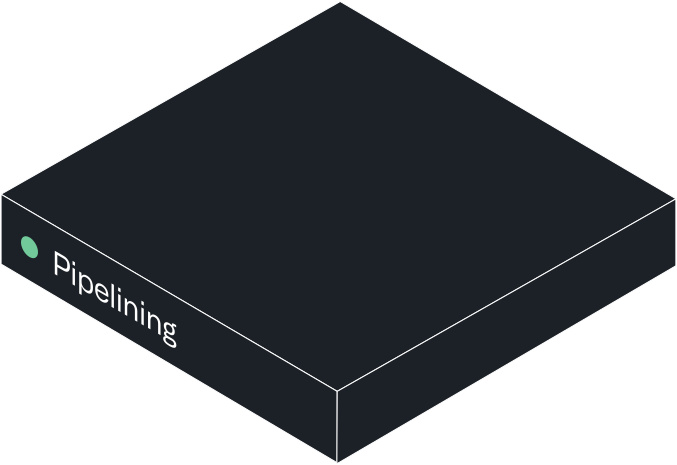 Data Pipelining in AIP
Scale-Agnostic Pipelining
Developers can leverage AIP’s powerful, out-of-the-box data transforms to process and clean data in any format and at any scale.
 Enterprise Connectivity
Federated Data Modeling
Connect securely to any source system. AIP's federated data model avoids costly and risky data duplication while enabling powerful, real-time data integration.
Run Any Code in Any Language, Anywhere
AIP is highly extensible, allowing developers to execute arbitrary custom code from within the platform without refactoring.
[0.1: Bring Container] ──> [0.2: Run in Workshop] ──> [0.3: Call via SDK]
- Bring any container into AIP: There is no need to rewrite legacy or custom code. If it can be containerized, it can run in AIP. Simply bring your Docker image to utilize it platform-wide.
- Run it directly from Workshop: Call your custom functions from anywhere within the platform. Configure front-end actions in Workshop to trigger containerized backend functions automatically.
- Call it from your custom Ontology SDK: Your containerized functions receive their own endpoints within your generated Ontology SDK, allowing you to write clean, type-safe code against them.
Infrastructure Management
- Integrate Code in Any Language: Run custom code packages without friction. Use Docker images to port existing algorithms, models, and business logic directly into the ecosystem.
- Automated Compute Scaling: Stop worrying about infrastructure provisioning. AIP guarantees high availability by dynamically scaling container replicas up or down based on current and historical workload demands.
- Bi-directional Connectivity: Write custom logic that interacts directly with native AIP features (such as reading and writing to tabular data or media sets) or connects directly to external third-party systems.
Focus on Alpha, Not Infrastructure
AIP frees development teams from managing production infrastructure. From automatic scaling to rigorous enterprise-grade security, the platform manages the operational overhead so you can focus on building core business value.
The AI platform that takes you from prototype to production.
Prototype, build, and deploy your AI-enabled applications in hours instead of months.
Comprehensive AI Development Capabilities
AIP organizes its core capabilities across five primary vectors: AI-First (01), Ontology (02), Media (03), Scaling (04), and Connectivity (05).
- The IDE for LLMs: Design and deploy AI applications with a built-in LLM function-builder, high-fidelity debugging environments, and a robust evaluation (evals) suite.
- Power Workflows with Any Model: Use the integrated Language Model Service to select from popular industry foundation models or register your own proprietary models.
- The Ontology Enables AI: The Ontology translates raw database schemas into semantic business concepts, making data easily digestible for LLMs and significantly reducing AI hallucinations.
- Integrate AI at Every Level: Inject LLMs natively across your entire software stack, including data pipeline transforms, backend functions, user-facing applications, interactive chats, and automation workflows.
Enterprise-Grade Foundations
- Sensible and Powerful Defaults: AIP’s underlying infrastructure has been stress-tested by the world's largest enterprises and government organizations. You only need to customize configurations when specific, unique needs arise.
- Eliminate Integration Friction: AIP bridges the structural gaps between disparate services that typically break down in complex, hand-rolled architectures, saving teams countless hours of debugging and maintenance.
Rapid Deployment Frameworks
Deploy production-ready systems faster than competitors can design mockups. AIP offers tailored interfaces designed for different development paradigms:
- AIP Workshop (App Builder): Build and deploy full-featured, interactive frontend applications rapidly. Workshop allows teams to construct production applications faster than traditional design-to-code pipelines.
- Pipeline Builder: Construct and deploy high-performance, maintainable data pipelines without writing a single line of boilerplate code.
- AIP Logic: Author, test, and deploy powerful, multi-step LLM functions and decision logic in minutes.
Built Out of Necessity
At Palantir, we built AIP to solve our own real-world engineering challenges:
- We build and deploy highly complex applications in the field—from factory floors to the tactical front lines.
- We needed an internal tool capable of automatically managing data connectivity, compute scaling, and security, allowing our deployment teams to focus entirely on the mission.
- AIP allowed us to accelerate our timeline from zero to prototype in minutes, and from prototype to production in hours.
- Today, we are opening this exact platform up to every developer in the world.
Key Takeaways
- Backend Automation: AIP’s Ontology-driven SDK generation eliminates the need to manually build, secure, and maintain backend APIs.
- Total Interoperability: Run any containerized code (Docker) and connect to any external data source without data duplication.
- AI-Native Infrastructure: Built-in LLM IDEs, evaluation suites, and model-agnostic integrations allow teams to safely embed AI into pipelines, front-ends, and functions.
- Rapid Time-to-Market: Leverage visual tools like Workshop, Pipeline Builder, and AIP Logic to move from concept to enterprise-grade production in hours.
Learning map
Stage 1: The Semantic Ontology
- Learn Object Modeling: Understand how Palantir Ontology defines data models, relations, and actions to represent real-world entities.
- Connect Data Sources: Learn to ingest and map enterprise datasets to Ontology objects without duplicating raw data.
Stage 2: Pro-Code App Development with Ontology SDK
- Generate Custom SDKs: Learn how to trigger SDK generation in TypeScript, Python, or OpenAPI formats from your Ontology schema.
- Write Object Queries: Practice querying, updating, and triggering actions on your Ontology objects using type-safe auto-generated code.
Stage 3: Containerized Logic and Custom Compute
- Bring Your Own Container (BYOC): Understand how to package custom python scripts or Docker images for execution inside AIP.
- Expose Custom Endpoints: Learn to expose containerized models and scripts as executable Ontology endpoints.
Stage 4: AI Workflow Orchestration
- Build with AIP Logic: Configure LLM-backed functions, high-fidelity prompt debugging, and evaluations to automate business actions.
- Deploy with AIP Workshop: Create user-facing reactive application front-ends integrated with your AI logic in minutes.
Get hands-on — step by step
- Define Your First Object: Log into your AIP instance, navigate to the Ontology Manager, and create a new Object Type (e.g.,
SupportTicket) with properties likeID,Status, andDescription. - Generate the SDK: Navigate to Developer Settings, select your Ontology, and generate a new Ontology SDK client package for TypeScript (NPM) or Python (Pip).
- Install and Authenticate: Initialize a local development directory, run
npm install @palantir/ontology-sdk(or pip install), and configure your API token environment variables. - Write an SDK Query: Create a script (
index.tsorapp.py) to initialize the client, query yourSupportTicketobjects, and output them to the console. - Containerize Custom Logic: Write a simple Python function that extracts key terms from a ticket, wrap it in a Docker container, and deploy it to AIP's container runtime environment.
- Build an AIP Workshop App: Open the AIP Workshop interface, drag a table widget to display your tickets, and attach a button action that calls your containerized term-extractor function.
Top 3 sources
- 1Palantir Foundry Ontology SDK Documentation
The official guide to understanding and using the Ontology SDK to build pro-code applications on Palantir's data layer.
https://www.palantir.com/docs/foundry/ontology-sdk/overview/
- 2Palantir AIP Product Page
Overview of the Artificial Intelligence Platform, highlighting enterprise LLM orchestration and Ontology integration.
https://www.palantir.com/platforms/aip/
- 3Palantir Developer Community Portal
The central hub for Palantir developers to ask questions, share tutorials, and discuss implementation strategies.
https://community.palantir.com/
Links are AI-suggested — worth a quick sanity check before diving in.